




The Universe's Ultimate Powerhouses
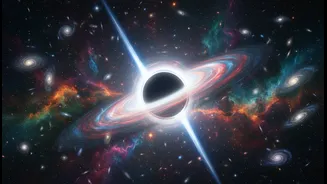
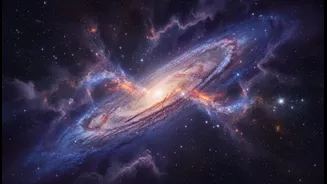
So, what is a quasar? The name itself, a shortening of "quasi-stellar radio source," sounds like something from a dense textbook. But the concept is thrilling. Imagine a black hole, not just any black hole, but a supermassive one billions of times heavier
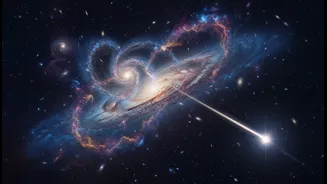
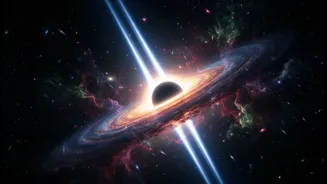
than our sun, sitting at the heart of a young galaxy. Now, imagine this monster is having a feast. As it pulls in colossal amounts of gas and dust, this material doesn't fall straight in. Instead, it forms a spinning, superheated whirlpool called an accretion disk. The friction and gravitational forces in this disk are so extreme that the matter heats up to millions of degrees, glowing with unimaginable intensity and blasting out energy across the cosmos. A quasar is this brilliant, blazing core, an engine so powerful it can be a thousand times brighter than a galaxy like our own Milky Way, with all its hundreds of billions of stars.
A Window to the Dawn of Time
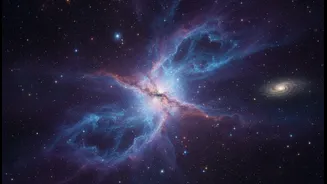
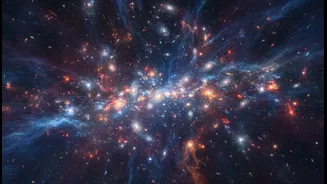
Quasars aren't just bright; they're incredibly distant. Because their light has taken billions of years to reach us, seeing a quasar is like looking through a cosmic time machine. The most ancient ones give us a direct view of the universe when it was less than a billion years old, a period known as the "cosmic dawn." By studying them, astronomers can piece together the story of how the first galaxies and black holes formed and grew. In early July 2026, the Euclid space telescope made headlines by discovering 31 ancient quasars, including two that are the most distant ever observed, dating back to when the universe was only about 670 million years old. These discoveries are helping to solve one of space's biggest puzzles: how did supermassive black holes get so massive, so quickly after the Big Bang?
The Jargon Trap
Despite being some of the most extreme objects in existence, the language used to describe quasars can be a barrier. Terms like "active galactic nuclei," "high redshift," and "accretion disk dynamics" are precise but not exactly inviting. When a student reads about an object being discovered at a "redshift of 7.77," the number is meaningless without heavy context. It’s a shorthand for saying the object is incredibly far away and from a very early cosmic era, but it doesn't convey the awe. This is the central challenge: the science is complex, and the terminology is built for expert-to-expert communication, not for firing up a teenager's imagination. The result is that one of the universe's most compelling stories—of galactic monsters and cosmic birth—gets hidden behind a wall of academic language.
Let's Rebrand the Quasar
The spirit of the headline for this very article is a call to do better. So, what would a student-friendly headline for a quasar discovery look like? Instead of focusing on the technical measurement, we could lead with the concept. Instead of: "Astronomers Detect Quasar J172902.75+641018.1 at Redshift 7.77" Let's try: "Found: A Cosmic Engine from the Universe's First Dawn" "Telescope Spots Black Hole 'Baby Picture' from 13 Billion Years Ago" "The Universe's Brightest Objects Are Also Its Oldest Ghosts" "This Galaxy's Core Is Brighter Than a Trillion Suns" These headlines frame the discovery around a core, relatable idea: age, power, brightness, or mystery. They act as a doorway to the deeper science, inviting the reader in rather than holding them at arm's length with technical terms. They trade jargon for wonder, which is the first step toward creating genuine interest.