






The New Workplace Reality
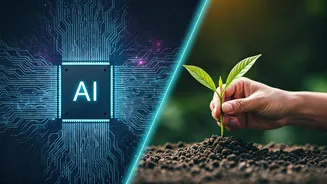
Artificial Intelligence is rapidly moving from a futuristic concept to a daily reality in the global job market. The World Economic Forum predicts that over the next five years, a significant majority of companies will adopt AI technologies. [21] This
isn't just about automating repetitive tasks; it's about fundamentally changing how work is done, creating new roles, and demanding a new set of skills. [10, 16] As AI handles more of the routine execution—processing information, generating content, and analyzing data—human value is shifting towards areas like problem-framing, contextual oversight, and making responsible decisions based on AI-generated insights. [16] This shift means that being 'workplace-ready' in the AI era is less about mastering a specific tool and more about developing a durable, adaptable skill set.
Foundations in School Education
Recognizing this global shift, India has begun to fundamentally rethink its educational approach. The National Education Policy (NEP) 2020 explicitly emphasizes integrating AI concepts at all educational levels to prepare students for an AI-driven economy. [14, 19] Initiatives are already in motion, with the CBSE introducing AI as an optional subject for classes IX to XII and even offering introductory modules for students as young as Class VI. [2, 17] The goal is to build a strong foundation in what are now considered basic literacies: computational thinking, data analysis, and digital ethics. [14, 23] By exposing students to these concepts early, the education system aims to cultivate a generation that is not just a passive user of technology but an active and critical participant in it. [14, 18]
The Critical Role of Higher Education
While K-12 education lays the groundwork, universities have a crucial role in deepening AI preparedness. It's no longer sufficient to confine AI education to computer science departments. [5] Institutions must integrate AI literacy across all disciplines, from business and marketing to healthcare and the arts. [5] The objective is to treat AI as a partner in learning, where students use it for research and brainstorming but are still required to perform the hard work of analysis, interpretation, and critical evaluation. [15] This approach mirrors the professional world, where AI supports tasks, but human judgment remains irreplaceable. [9, 15] In India, colleges are increasingly offering AI-based courses and training teachers to use AI tools, preparing students to either build or work with these complex systems. [24]
More Than Technical Know-How
Perhaps the most significant shift in the AI era is the rising value of uniquely human skills. As AI excels at technical and repetitive tasks, it's the soft skills that create a competitive edge. [4, 6] Research shows that employers are increasingly prioritizing attributes like critical thinking, communication, collaboration, creativity, and emotional intelligence. [3, 7] These skills are not just complementary to AI; they are essential for leveraging it effectively. [4] For example, critical thinking is needed to evaluate AI-generated outputs, creativity is required to solve problems that AI can't, and emotional intelligence is vital for leadership and teamwork. [3, 8] In fact, some research suggests that a significant portion of the value derived from advanced technical skills is dependent on these underlying foundational abilities. [3] The future of work belongs to those who can blend human strengths with technological capabilities. [8]
A Continuous Journey of Learning
The rapid evolution of AI means that workforce readiness is not a one-time achievement but a continuous process of learning, unlearning, and reskilling. [21] Experts advise that professionals should focus on figuring out which AI tools are relevant to their jobs and how to use them to enhance performance, rather than fearing replacement. [21] The government of India, through initiatives like the Pradhan Mantri Kaushal Vikas Yojana (PMKVY) and FutureSkills PRIME, is actively promoting lifelong learning and upskilling in AI and other digital domains. [17, 25] These programs aim to equip the entire workforce, from students to seasoned professionals, with the capabilities needed to adapt. [19] The most valuable skill in an AI-augmented world may be the ability to learn and adapt continuously. [10]