





The Building Blocks of Worlds
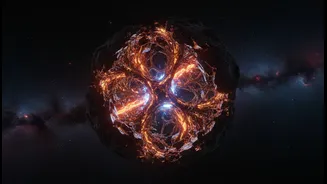
To understand planets, you have to go back to the beginning. Billions of years ago, our solar system was a chaotic disc of dust and gas. This material clumped together, forming kilometre-sized bodies called planetesimals. They are the fundamental building
blocks of planets. Through countless collisions and mergers, these planetesimals grew into the planets we know today, including Earth. During this formation, heavier elements like iron and nickel sank to the centre, forming a dense metallic core, while lighter materials formed the rocky mantle and crust. Unfortunately, these cores are buried thousands of kilometres beneath the surface, making them impossible to study directly.
An Asteroid Like No Other
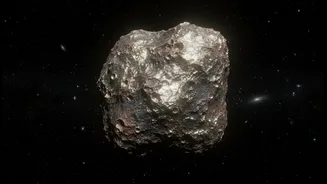
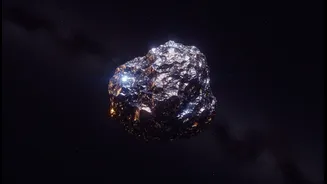
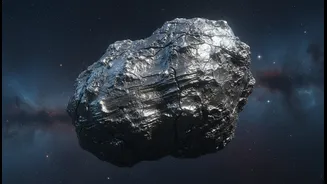
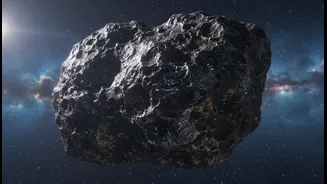
Enter 16 Psyche. Orbiting in the main asteroid belt between Mars and Jupiter, Psyche is not like its rocky or icy neighbours. It appears to be a giant, exposed lump of metal, primarily nickel and iron, about the size of Massachusetts. Scientists have a tantalising theory: Psyche is not just an asteroid, but the leftover core of an ancient planetesimal. This world-in-the-making likely suffered a series of violent hit-and-run collisions that stripped away its rocky mantle, leaving its metallic heart exposed to space. This makes Psyche an invaluable and unique opportunity—the only way humanity can ever visit a planetary core.
A Mission to a Metal World
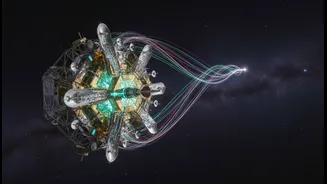
In response to this unique opportunity, NASA launched the Psyche mission in October 2023. The robotic spacecraft is now on a multi-year journey, having already performed a gravity-assist flyby of Mars in May 2026 to help set its course. Upon its arrival in August 2029, the probe will spend nearly two years orbiting the asteroid, using a suite of instruments to map its surface, determine its composition, and look for evidence of a past magnetic field. One of its primary goals is to determine if Psyche is indeed a planetary core or something else entirely, like primordial material that never melted. This will provide unprecedented insight into the violent history of our solar system's creation.
The Power of Radio Telemetry
While cameras and spectrometers will study the surface, the key to understanding Psyche's interior lies in its telemetry. Telemetry is simply the stream of data a spacecraft sends back to Earth. For the Psyche mission, this includes data from its X-band radio telecommunications system. Here's how it works: NASA's Deep Space Network sends a radio signal to the spacecraft, which receives it and sends a signal back. Scientists on Earth can measure the frequency of this return signal with incredible precision. This constant back-and-forth acts like a cosmic measuring tape, allowing engineers to know exactly where the probe is and how fast it's moving.
Mapping Gravity with Radio Waves
The real genius of this system is how it's used for gravity science. As the Psyche probe orbits the asteroid, it will be pulled by Psyche's gravity. If a part of the asteroid below is denser, its gravitational pull will be slightly stronger, causing the spacecraft to speed up by a minuscule amount. If a region is less dense, the pull is weaker, and the probe slows down. These tiny changes in speed cause a corresponding tiny shift in the frequency of the radio signal it sends back to Earth—a phenomenon known as the Doppler effect. By meticulously tracking these Doppler shifts in the telemetry data, scientists can build an incredibly detailed map of the asteroid's gravity field. This gravity map, when combined with topography data from the imager, reveals how mass is distributed throughout Psyche's interior, providing definitive clues about its structure and confirming whether it's a solid metal core or something more complex.