


A Panoramic Window to the Cosmos
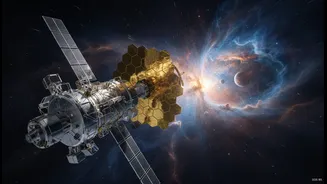
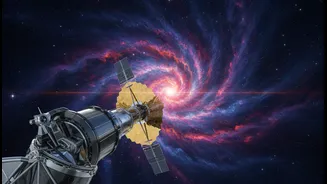
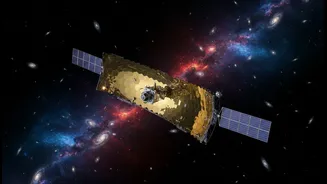
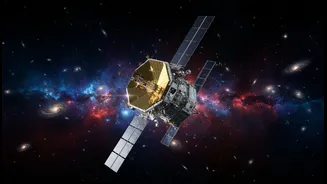
Set to launch by August 2026, the Roman Space Telescope is not just another telescope; it's a cosmic surveyor of unprecedented scale. While missions like the Hubble and James Webb Space Telescopes zoom in to capture deep, detailed images of small patches
of sky, Roman is built for breadth. Its primary tool, the Wide-Field Instrument, boasts a view 100 to 200 times larger than Hubble's infrared camera. This means in a single snapshot, Roman can capture a portion of the sky larger than the full moon. What took Hubble years to survey, Roman can accomplish in mere months, creating vast cosmic maps that will help scientists understand the universe's large-scale structure. It will do this while maintaining a similar image sharpness to Hubble, providing both speed and clarity.
Chasing the Ghosts: Dark Energy and Dark Matter
About 95% of our universe is made of dark energy and dark matter, mysterious substances we can't see or directly detect. We only know they exist because of their gravitational effects on the things we can see. Dark energy, for instance, is the force believed to be causing the universe's expansion to accelerate. Roman's primary mission is to tackle this enigma head-on. By surveying billions of galaxies and mapping their distribution across cosmic time, the telescope will provide crucial data on how dark energy has shaped the universe. It will use three key methods: studying the distribution of galaxies, observing distant stellar explosions called Type Ia supernovae, and measuring how the light from distant galaxies is bent by gravity—a phenomenon known as weak gravitational lensing. These observations will allow scientists to test Albert Einstein's theory of gravity on cosmic scales and understand the past and future of our universe.
A Census of New Worlds
Beyond the grand cosmic structure, Roman will also conduct a massive search for planets outside our solar system. While missions like Kepler looked for the dip in a star's light as a planet passes in front (the transit method), Roman will primarily use a different technique called gravitational microlensing. This effect, predicted by Einstein, occurs when a star and its planet drift in front of a more distant star. The gravity of the foreground star acts as a natural lens, magnifying the light from the background star. The orbiting planet creates a smaller, secondary blip in this magnification. This method is incredibly sensitive, allowing Roman to find planets down to the mass of Mars, including worlds much farther from their stars than most other techniques can detect. Scientists predict Roman could discover thousands of new exoplanets, including rogue planets that drift through space without a parent star, providing a more complete census of the planets in our galaxy.
Seeing the Unseen: Black Holes and First Stars
Roman's powerful survey capabilities will also open new windows into some of the most extreme objects in the universe. Recent research suggests Roman will be able to detect supermassive black holes in the very early universe, up to 11 billion years ago. It will do this by spotting tidal disruption events (TDEs), the intensely bright flares that occur when a star gets too close to a black hole and is torn apart. Spotting these events in the distant past will help scientists understand how these cosmic behemoths formed and grew. In a similar way, astronomers hope to use Roman to find evidence of the universe's very first stars, known as Population III stars. These stars were massive, bright, and short-lived, and by hunting for the unique signature of their TDEs, Roman could give us our first glimpse into the cosmic dawn.