


A New Look at an Old Neighbour
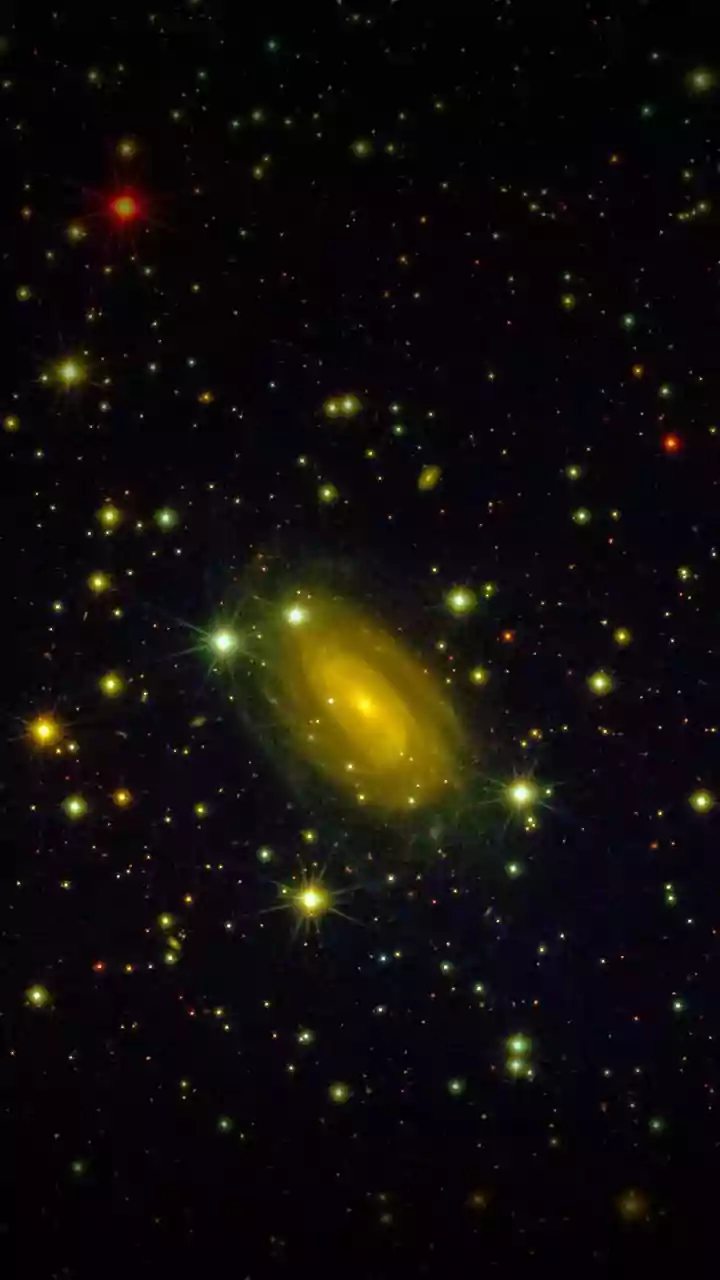
For decades, the galaxy Centaurus A was a familiar, if somewhat fuzzy, sight to astronomers. Located about 13 million light-years away, it's one of the brightest objects in the southern night sky, known for its peculiar shape and dark, dusty lanes. Astronomers
knew it was the result of a colossal merger between two galaxies billions of years ago. But what lay behind that veil of dust remained largely a mystery. Now, stunning new images from the James Webb Space Telescope (JWST) have pierced through the haze, providing a view of the galaxy's heart with unprecedented clarity. Where older telescopes saw a blur, the JWST sees millions of individual stars, offering a crystal-clear snapshot of the aftermath of that ancient cosmic collision.
The Power of Seeing Clearly
This newfound clarity isn't magic; it's the result of cutting-edge technology. The James Webb Space Telescope is the largest and most powerful observatory ever sent into space. Its massive 6.5-meter primary mirror and its ability to see in the infrared part of the spectrum allow it to achieve two crucial things. First, infrared light can pass through the dense clouds of cosmic dust that would normally block our view, like the ones that obscure the centre of Centaurus A. Second, its sheer size and advanced instruments give it extraordinary resolution, the ability to distinguish fine details. Think of it as upgrading from an old tube television to the latest 8K screen. Suddenly, what was a grainy, indistinct blob resolves into a sharp, detailed picture, revealing structures and objects that were simply invisible before.
From a Sharper Picture to a New Paradigm
These new, high-resolution views are more than just pretty pictures; they are treasure troves of scientific data. In Centaurus A, astronomers can now see the chaotic yet intricate aftermath of its galactic merger. They've identified strange, S-shaped filaments and a warped, parallelogram-like structure near the core that have no simple explanation. Furthermore, the ability to resolve millions of individual stars allows scientists to perform what they call 'galactic archaeology'. By studying the different populations of stars, they can reconstruct a timeline of the galaxy's life: when the first stars formed, when activity slowed, and how the merger triggered a fresh burst of star birth. This detailed history was impossible to write when the galaxy was just a fuzzy patch of light.
The Birth of Galactic Archaeology
This is what the headline means by a 'new field'. The ability to perform detailed 'archaeology' on a galaxy outside our own is a revolutionary step. Previously, such analysis was largely confined to our own Milky Way, where we can study individual stars more easily. Now, with the power of telescopes like the JWST, any relatively nearby galaxy becomes a potential dig site. Astronomers can start to compare the life stories of different galaxies, testing theories about how they form, evolve, and die. For example, the new images of Centaurus A are providing vital clues about how the supermassive black hole at its centre is influenced by, and in turn influences, the surrounding galaxy. This shift from broad-strokes observation to detailed, historical reconstruction marks the true beginning of comparative galactic archaeology, a field made possible entirely by better resolution.
Why It Matters on Earth
This leap forward in cosmic understanding has profound implications back on Earth. For India, which has a burgeoning space programme and a deep pool of scientific talent, these developments represent immense opportunities for collaboration and discovery. The technological innovations driving these telescopes often lead to spinoffs in fields like medicine, materials science, and computing. Moreover, these breathtaking views of the cosmos serve as a powerful inspiration, encouraging a new generation of students to pursue careers in science, technology, engineering, and mathematics (STEM). At its core, this story is a powerful reminder that progress often comes not from finding something entirely new, but from gaining the ability to see the familiar world around us with fresh eyes and in greater detail than ever before.