


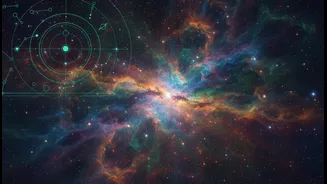


What is a 'Crimson Nebula'?
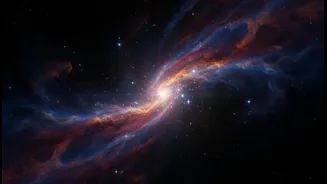
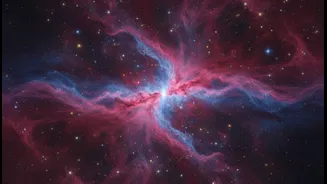
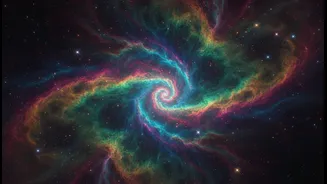
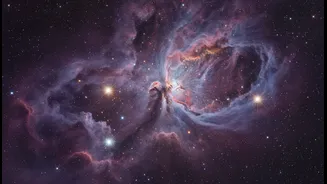
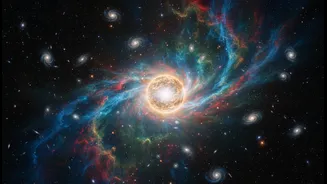
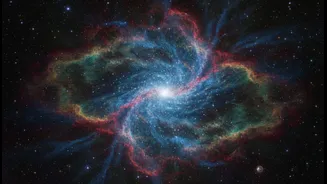
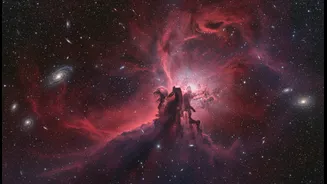
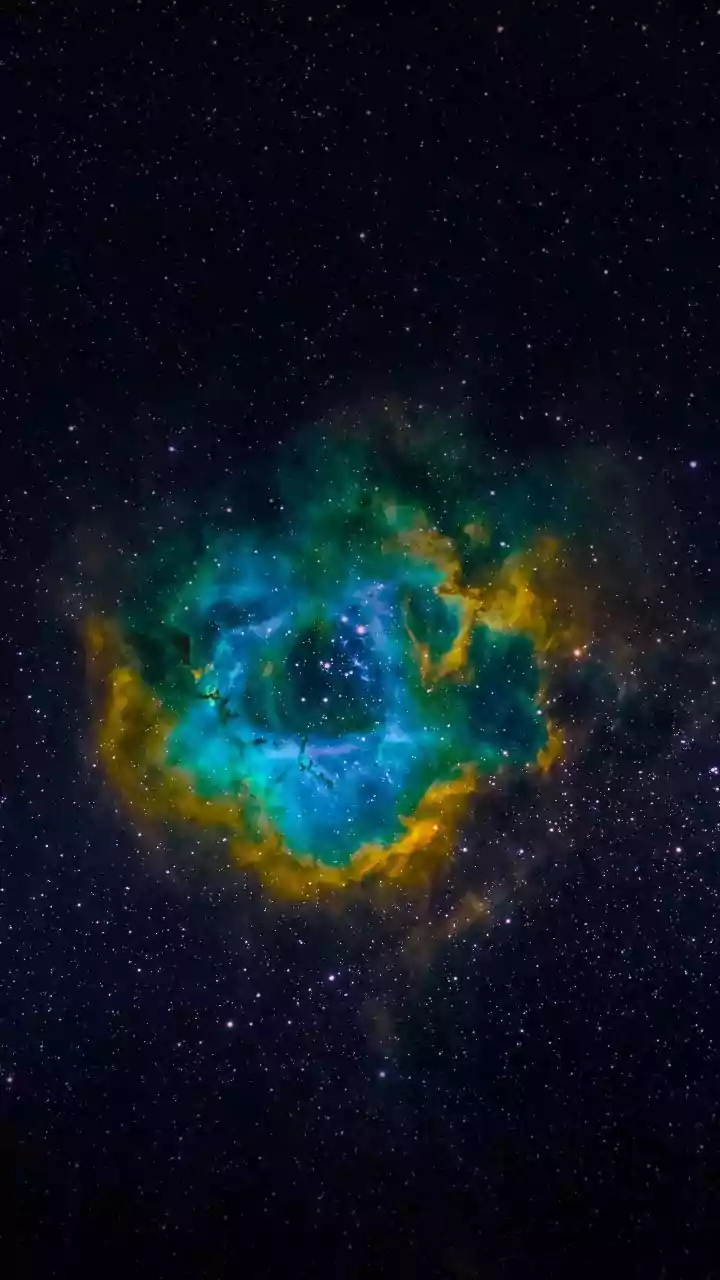
The term 'crimson nebula' doesn't refer to one specific spot in the sky, but rather describes a breathtaking category of celestial objects. These are vast clouds of interstellar gas and dust, primarily hydrogen, that glow a brilliant red. This crimson hue
is the signature of intense energy, usually from massive, young stars embedded within them. Their powerful ultraviolet radiation excites the surrounding hydrogen gas, causing it to emit a specific wavelength of red light known as hydrogen-alpha. Stellar nurseries like LH 95, located in a nearby galaxy called the Large Magellanic Cloud, are spectacular examples, appearing as landscapes of crimson smoke punctuated by brilliant blue and white stars. These regions are not just beautiful; they are active laboratories for understanding star formation, and their vibrant colours make them compelling targets for observation and study.
From Ivory Towers to Open Archives
For centuries, the study of the cosmos was a walled garden. Access was limited to those with powerful telescopes, advanced degrees, and positions at major observatories. The universe was something most people could only read about. This is no longer the case. A seismic shift has occurred, driven by technology and a new philosophy of open access. Space telescopes like the Hubble and the James Webb Space Telescope (JWST) are not just scientific instruments; they are public resources. They generate a torrent of data and imagery that is made available online, often within days of being captured. This move towards 'open data' has democratised the universe, providing the raw materials for discovery to anyone with an internet connection. The JWST, with its powerful infrared vision, has been particularly revolutionary, peering through cosmic dust to reveal the universe's earliest structures in unprecedented detail and making that data widely available.
The Rise of the Citizen Scientist
This flood of data has powered the rise of citizen science, where amateur enthusiasts collaborate with professional researchers to analyze information. In India, this movement has achieved remarkable success. One of the leading platforms is RAD@home, an astronomy collaboratory founded to train students and volunteers to analyze telescope data from their homes. In a recent, stunning example of this model's power, a citizen scientist from a remote village in Sikkim, participating in a RAD@home session, made the initial discovery of a colossal and unique structure now nicknamed the 'Bow-and-Arrow' radio galaxy. This object, a galaxy moving at supersonic speeds through a cluster, created a shock wave spanning nearly 1.8 million light-years. Automated systems had previously missed its unusual shape, but a trained human eye caught the anomaly, leading to a significant astronomical finding published in a major scientific journal. This highlights a crucial point: in an age of algorithms, human pattern recognition remains an invaluable tool for discovery.
A Universe Beyond Sight
Making astronomy accessible goes beyond just providing data; it means making it perceivable to everyone, regardless of physical ability. Recognizing this, scientists are developing innovative ways to represent cosmic wonders. For the visually impaired, the stunning images from the JWST are accompanied by incredibly detailed written descriptions, or 'alt text'. These evocative descriptions translate the visual spectacle of swirling galaxies and nebulae into rich, narrative prose that can be read by screen readers. Another pioneering technique is 'data sonification,' which converts astronomical data—such as the light from a star or the radio waves from a galaxy—into sound. This allows researchers and enthusiasts to 'hear' the patterns in the cosmos, opening up a new sensory dimension for exploration and making astronomical research accessible to those who cannot see.
Your Invitation to Explore
The beauty of a crimson nebula is no longer a sight reserved for a select few. The universe is issuing an open invitation, and there are countless ways to accept. Global platforms like Zooniverse host dozens of projects where you can help classify galaxies, identify supernovae, or search for planets around other stars, all with a simple web browser. For those in India, initiatives like RAD@home provide training and a direct path to contributing to active research. Local amateur astronomy clubs, many of which are part of larger networks like the Astronomical League, offer observing programs and a community of fellow stargazers. Whether by analyzing data, joining a star party, or simply gazing up at the night sky, the tools to participate in one of humanity's oldest quests are now more accessible than ever.