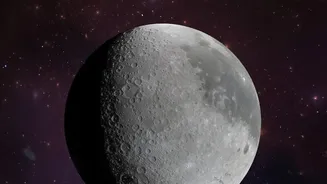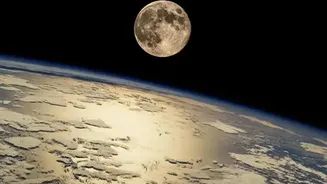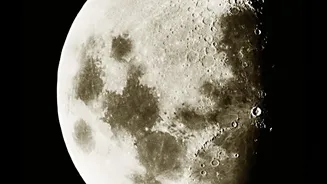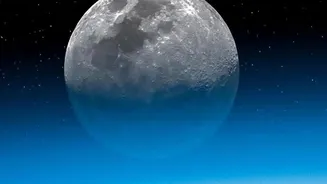




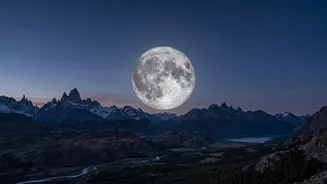
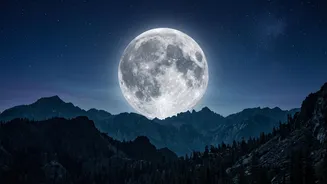
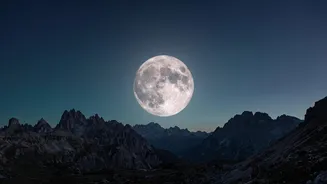
You’ve seen it: a giant, breathtaking moon rising over the horizon, looking close enough to touch. Hours later, it's a small, lonely disc overhead. But what if your eyes are lying? They are, and your phone's camera can prove it.
That Jaw-Dropping Horizon Moon
It’s one of the sky’s most
universal and captivating shows. A full moon cresting over a distant treeline or cityscape often appears impossibly large and heavy, glowing with an orange hue that feels more cinematic than real. It commands attention. Yet, as the night wears on and the Moon climbs higher, the magic seems to fade. That same celestial body shrinks, becoming a modest white dot in the vast, empty expanse of the night sky. The shift is so dramatic that for centuries, people believed the atmosphere must be magnifying the low-hanging Moon like a lens. The truth, however, is far more fascinating and has everything to do with the complex machinery inside your head, not the sky.
Your Camera Is the Ultimate Truth-Teller
Here's where photography provides the definitive proof mentioned in the headline. If you take a picture of the enormous-looking horizon moon with your phone or camera (without using a powerful zoom lens), you might be disappointed. The Moon will look surprisingly small in the photo. Later that night, take another picture with the exact same settings when the Moon is high in the sky. When you compare the two images, you'll find the Moon is the same size in both. In fact, the horizon moon is technically about 1.5% farther away from you than the overhead moon, so if anything, it should appear slightly smaller. The camera simply captures the angular size of the Moon—the amount of space it takes up in the sky—which is consistently about half a degree. Your eyes see a giant, but the camera captures a constant, proving the 'bigness' is a powerful and convincing illusion. You can even test it without a camera: hold a dime at arm's length, and you'll find it covers the Moon just as well on the horizon as it does at its zenith.
Your Brain Is Playing Tricks on You
So if the Moon isn’t actually bigger, why does it feel so overwhelmingly large? The answer lies in how your brain interprets the world. The leading explanation is a combination of two powerful psychological effects, the first being the 'Apparent Distance Hypothesis'. When you look toward the horizon, your brain sees a landscape filled with depth cues: trees, buildings, and mountains. It knows these objects are far away. Because the Moon appears behind these distant objects, your brain assumes it must be even farther away. Your brain then applies a rule of logic: if two objects take up the same amount of space in my field of vision, but one is much farther away, the distant one must be physically enormous. When the Moon is high in the sky, there are no reference points, just empty space. With no cues to suggest great distance, your brain perceives the sky as being 'closer' and concludes the Moon is, therefore, smaller.
It’s Like a Giant Ponzo Illusion
This trick of the mind is a version of the classic Ponzo illusion, often demonstrated with two identical horizontal lines drawn over converging railroad tracks. The line drawn on the part of the tracks that appears farther away looks longer than it is. In any case of many similar illusions involving perspective and distance perception.