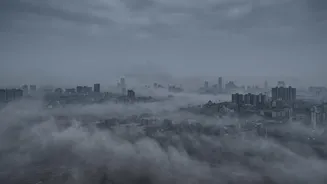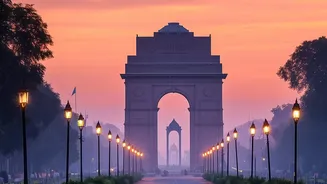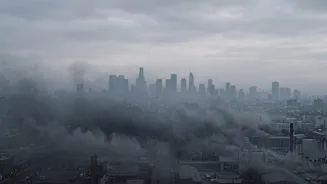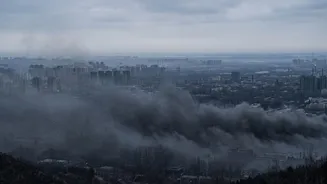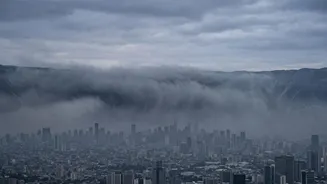






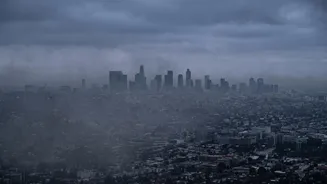
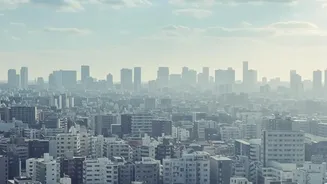
Every winter, a familiar grey haze descends upon Delhi, turning the sky a murky brown and making the air thick and difficult to breathe. But this isn't just about emissions. It's a perfect storm brewed by meteorology. Here's what's happening.
The Atmosphere's Winter Lid
The single
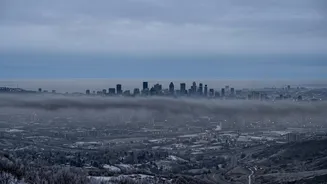
biggest meteorological factor behind Delhi's winter pollution is a phenomenon called 'temperature inversion'. Normally, the air closer to the ground is warmer and rises, carrying pollutants with it and dispersing them high into the atmosphere. But during winter nights, the ground cools rapidly, chilling the air just above it. This creates a situation where a layer of warmer air sits on top of this cooler, denser air, acting like a lid on a pot. This inversion traps everything—from vehicle exhaust to industrial emissions—near the surface, right where we breathe. This lid is often at its lowest and most effective in the early morning hours, which is why air quality readings typically peak after sunrise.
Calm Winds That Offer No Relief
If temperature inversion traps pollution vertically, low wind speeds trap it horizontally. After the monsoon season, wind patterns over northern India change dramatically. The typically brisk winds that help clear the air die down, becoming sluggish and calm, often dropping below 10 km/h. Without strong winds to blow the polluted air away, the toxic mix remains suspended over the city for extended periods. This lack of ventilation means that new emissions from traffic, industry, and other sources are continuously added to an already stagnant pool of polluted air, causing concentrations of harmful particles to build day after day.
The Geographical Bowl Effect
Delhi's geography plays a significant role in its pollution woes. The city is located in the vast Indo-Gangetic plains, which are bordered by the towering Himalayas to the north. This topography creates a natural 'bowl' effect. During winter, when winds are generally light, this geographical barrier prevents pollutants from dispersing northwards. The trapped air mass has nowhere to go, leading to accumulation across the entire region. This effect ensures that even if Delhi were to halt all its local emissions, it would still be susceptible to poor air quality due to regional atmospheric patterns.
Unwanted Smoke From Upwind
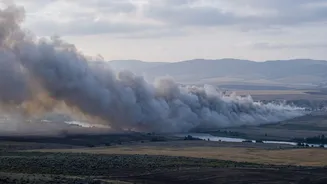
While not a meteorological event itself, stubble burning in the neighbouring states of Punjab and Haryana becomes a crisis because of winter weather patterns. During October and November, prevailing northwesterly winds act as a transport corridor, carrying massive plumes of smoke directly towards Delhi. This smoke, laden with fine particulate matter (PM2.5), arrives just as Delhi's own meteorological conditions—the temperature inversion and calm winds—are creating the perfect environment to trap it. Studies have shown that during its peak, smoke from farm fires can contribute significantly to Delhi's hazardous PM2.5 levels, turning 'very poor' air into 'severe' almost overnight.
The Role of Low Mixing Height
Related to temperature inversion is the concept of 'mixing height'. This is the vertical altitude up to which pollutants can disperse in the atmosphere. In the summer, the mixing height over Delhi can be a kilometre or more, giving pollutants a large volume of air to diffuse into. However, during winter, the stable atmospheric conditions caused by inversions can shrink this mixing height to just a few hundred metres, sometimes even below 200 metres. This drastically reduces the 'breathing space' of the city's atmosphere, concentrating the same amount of pollution into a much smaller volume of air and sending AQI readings soaring.