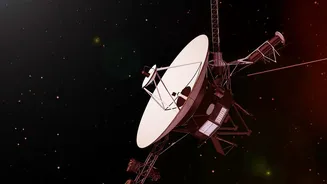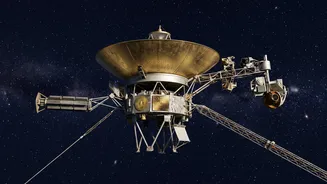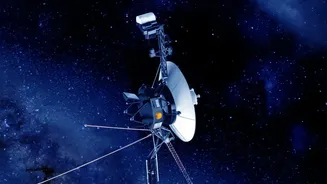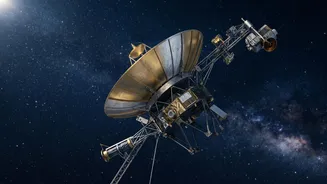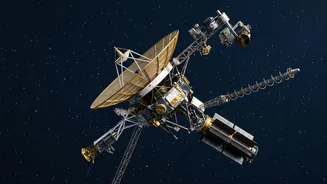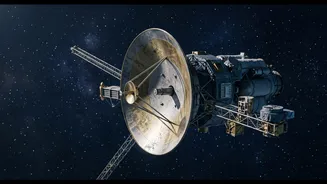




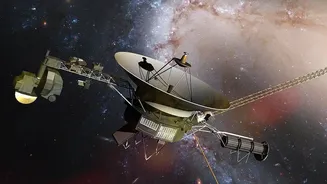
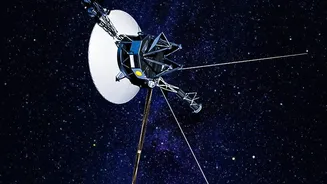
Humanity’s farthest messenger, Voyager 1, has once again shown its resilience. After a tense 48-hour silence in October 2026, the aging probe re-established contact, a relief for the engineers who manage this nearly 50-year-old marvel.
A Sudden Silence
Imagine trying to
hear a whisper from 25.9 billion kilometres away. That is the daily reality for NASA’s Deep Space Network, which listens for signals from Voyager 1. For two days in mid-October 2026, that whisper stopped. During two scheduled communication attempts on October 18 and 19, the giant radio antennas on Earth heard nothing but static. For a mission that has been running since 1977, any unexpected silence is cause for concern. The team at NASA's Jet Propulsion Laboratory (JPL) braced for a complex, long-distance troubleshooting process where a single command takes nearly a day to reach the spacecraft.
A Fortunate Resolution
Then, on October 20, just as mysteriously as it had vanished, Voyager 1’s signal returned. The spacecraft had fixed itself before mission control could even send a command. Investigations revealed that the probe’s autonomous fault protection system had kicked in. It detected an issue with the primary set of thrusters, automatically switched to a backup set, and placed itself in a stable ‘safe mode’ to await instructions. While engineers are still investigating the root cause, the event was a testament to the probe's robust 1970s engineering. Kareem Badaruddin, the Voyager mission manager, noted that while it was the first time they’d seen this particular behaviour, 'we have to expect the unexpected' at this stage of the mission.
The Race Against Fading Power
The communication scare unfolded against a backdrop of a much larger, slower-moving challenge: power. Voyager 1’s nuclear power source, which started with 470 watts at launch, loses about 4 watts of output every year. To keep the mission alive, engineers have become masters of energy conservation, shutting down instruments and heaters over the years. Just weeks before the blackout, in September 2026, the team executed a clever power-saving manoeuvre nicknamed the 'Big Bang'. They simultaneously swapped out three energy-hungry warming devices for lower-power alternatives, a delicate operation that will allow the remaining science instruments to function longer than previously hoped.
Humanity's Farthest Emissary
This ongoing struggle for survival is about more than just keeping an old machine running. Voyager 1 is humanity’s only active probe in interstellar space, the region between the stars. It crossed the boundary of our sun’s influence, the heliopause, back in 2012. Even with only two of its ten original science instruments still active—a magnetometer and a plasma wave detector—it continues to send back invaluable data about an environment no other spacecraft has ever sampled directly. On November 18, 2026, the probe will achieve another incredible milestone, reaching a distance of one light-day from Earth, meaning its signals now take a full 24 hours to reach us. It is a lonely outpost carrying its Golden Record, a testament to human ingenuity and our unyielding curiosity to explore what lies beyond.