



A New Cosmic Powerhouse
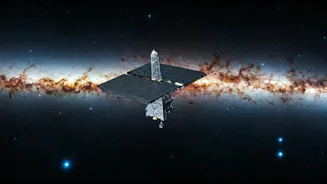
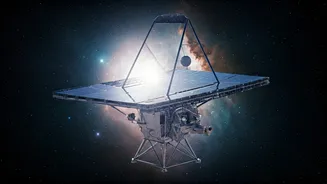
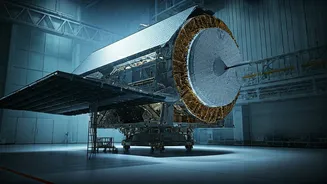
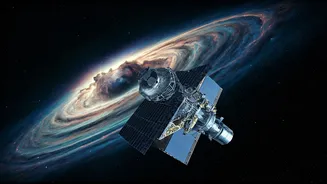
Named after Dr. Nancy Grace Roman, NASA's first chief of astronomy and the “mother” of the Hubble Space Telescope, the Roman Telescope is the agency's next great observatory. [2, 5] Having arrived at NASA's Kennedy Space Center in Florida on June 21,
2026, the spacecraft is now in the final stages of preparation for a launch targeted for no earlier than August 30. [10, 22] This represents a significant acceleration, putting the mission well ahead of its original 2027 launch commitment. [10] Once launched aboard a SpaceX Falcon Heavy rocket, it will travel to an orbit about 1.5 million kilometers from Earth, a stable gravitational point known as L2. [1, 17] From there, its five-year primary mission will begin: to tackle fundamental questions about dark energy and exoplanets. [5, 6]
Seeing the Bigger Picture
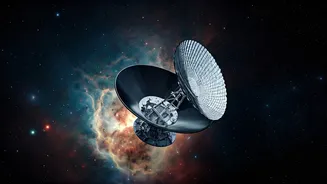
Roman's primary advantage is its sheer field of view. While its 2.4-meter primary mirror is the same size as Hubble's, its Wide Field Instrument (WFI) can capture a patch of the sky at least 100 times larger than Hubble's infrared camera. [2, 13] This panoramic capability will allow it to map the sky with incredible speed and efficiency. To put it in perspective, a deep-sky survey that would take Hubble years to complete could be done by Roman in a matter of days. [15] This wide-angle vision is crucial for its mission to conduct massive surveys, capturing images of billions of galaxies and hundreds of millions of stars to create unprecedented maps of the universe. [8, 19]
Unraveling the Mystery of Dark Energy
One of Roman's two primary science goals is to investigate the nature of dark energy, the mysterious force causing the universe's expansion to accelerate. [6, 8] Scientists still don't know what it is, and Roman will attack the problem in multiple ways. By surveying billions of galaxies, it will map their distribution across cosmic time. [8] It will also use a technique called weak gravitational lensing, studying how the light from distant galaxies is subtly distorted by clumps of dark matter. [5] Finally, it will search for thousands of distant supernovae. By measuring how these cosmic events have receded over time, scientists can trace the expansion history of the universe, providing crucial clues about the dark energy that drives it. [8]
Hunting for New Worlds and Testing New Tech
Roman's second main objective is a massive census of exoplanets—planets orbiting other stars. [6] While observatories like Kepler and TESS found thousands of planets by watching for the dip in starlight as a planet passes in front of its star, Roman will primarily use a different technique called gravitational microlensing. [7] This method can detect planets far from their star, including free-floating "rogue" planets not bound to any star at all. Roman is expected to discover thousands of new exoplanets, providing a statistical treasure trove for understanding planetary systems. [8] The telescope also carries a technology demonstration called the Coronagraph Instrument. [3] This advanced system is designed to block the overwhelming glare of a star to directly image the faint planets orbiting it—a capability 100 to 1,000 times better than existing space-based coronagraphs. [3, 9] This will serve as a critical pathfinder for future missions aiming to image Earth-like planets, such as the planned Habitable Worlds Observatory. [11]
A Complement to Hubble and Webb
The Roman Telescope is not a replacement for Hubble or the James Webb Space Telescope (JWST) but a powerful complement. While Hubble observes in ultraviolet, visible, and near-infrared light, and Webb is optimized for deep infrared views of the early universe, Roman is a wide-field survey machine operating in visible and near-infrared wavelengths. [21] Think of Hubble and Webb as microscopes, providing incredibly detailed views of specific, small targets. Roman, by contrast, is a wide-angle camera, designed to create vast panoramas of the cosmos with the same sharp resolution as Hubble. [21] Its rapid surveys will identify countless new targets and cosmic events, creating a rich dataset that other telescopes, including Hubble and Webb, can then study in greater detail. [21]