



A Priceless Glimpse of the Corona
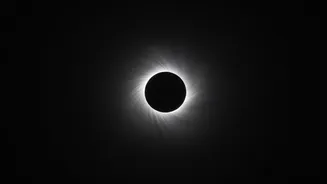
A total solar eclipse offers scientists a rare, unobstructed view of the Sun's outer atmosphere, the corona. Normally, the brilliant surface of the Sun, the photosphere, is so overwhelmingly bright that it washes out the much fainter corona, which is about
as bright as a full moon. Ground-based and even space-based telescopes can create artificial eclipses using instruments called coronagraphs, but these inevitably block the innermost part of the corona. A natural eclipse, however, allows a perfect, fleeting view right down to the Sun's edge, revealing structures and dynamics that are otherwise hidden. This brief window is critical for tackling some of the biggest unanswered questions in solar physics.
The Coronal Heating Mystery
One of the most persistent puzzles for solar physicists is the coronal heating problem. The Sun's visible surface is about 5,500 degrees Celsius, yet the corona, which extends millions of kilometres into space, sizzles at over a million degrees. How the atmosphere gets hotter the farther it is from the heat source defies simple explanation. Studying the fine structures, plasma loops, and magnetic field interactions visible only during an eclipse provides crucial data for models that attempt to explain this phenomenon. Each eclipse offers a snapshot of the corona's state at a specific moment in the Sun's 11-year activity cycle, providing new pieces to solve this long-standing puzzle.
High-Flying Observatories Join the Chase
To maximize their observation time and overcome potential weather issues, NASA deployed a WB-57 high-altitude research aircraft. Flying at 50,000 feet along the eclipse path over the Atlantic, the jet chased the Moon's shadow, extending the view of totality from just over two minutes on the ground to nearly three. Equipped with a suite of advanced cameras taking high-resolution images in multiple wavelengths, the aircraft captured data on the corona's temperature and the origins of the solar wind. Flying above the clouds and much of the atmosphere also allowed for clearer observations in infrared light, which is typically absorbed before it reaches the ground.
Balloons, Rockets, and Global Collaboration
The research effort wasn't confined to a single jet. The NASA-supported Nationwide Eclipse Ballooning Project launched dozens of scientific balloons from Iceland and Spain. In Iceland, 80 balloons were released to study how Earth’s boundary layer—the part of the atmosphere closest to the ground—reacts to the sudden drop in solar radiation. Previous experiments showed the layer collapsed in clear skies but not cloudy ones, and researchers were keen to see how the unique atmospheric conditions in Iceland would compare. Meanwhile, student teams in Spain launched balloons equipped with 360-degree cameras to capture stunning imagery and conduct similar atmospheric tests, making this a truly global and collaborative scientific event.
Looking Ahead to Years of Data
While the eclipse itself lasted only minutes, the scientific return will last for years. The vast amounts of data collected from the WB-57 jet, the balloon projects, and ground-based observatories across Europe will now be meticulously analyzed. Researchers will compare the high-fidelity images with predictions from computer models, aiming to refine our ability to forecast space weather—the stream of charged particles from the Sun that can impact satellites and power grids on Earth. For scientists, the August 12 eclipse wasn't an endpoint; it was the beginning of a new wave of discovery that will deepen our understanding of our star and its profound influence on the solar system.