




The Foundational Squat
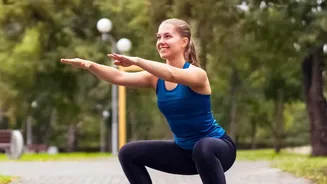
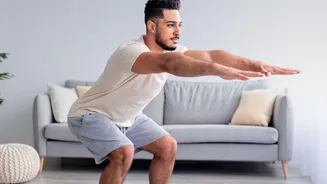
The bodyweight squat is a fundamental movement that strengthens your entire lower body, including your quadriceps, hamstrings, and glutes, while also engaging your core. To perform a proper squat, stand with your feet shoulder-width apart, with your toes
pointed slightly outward. Begin the movement by pushing your hips back as if you're about to sit in a chair, keeping your chest up and your back straight. Lower yourself until your thighs are parallel to the floor, or as low as you can comfortably go while maintaining good form. Ensure your knees track over your feet and don't collapse inward. Push through your heels to return to the starting position. For beginners, practicing with a chair behind you can help you master the form without going too low.
The Essential Push-Up
The push-up is a classic upper-body exercise that targets your chest, shoulders, and triceps, while also strengthening your core. If you're a beginner, a standard push-up can be challenging. A great way to start is with a modified version, such as incline push-ups or knee push-ups. For an incline push-up, place your hands on a stable, elevated surface like a countertop or a sturdy bench. The higher the surface, the easier the exercise. For a knee push-up, start on all fours and then extend your body so it forms a straight line from your head to your knees. In both variations, keep your core engaged and your back flat as you lower your chest toward the surface or floor, then press back up.
The Core-Strengthening Plank
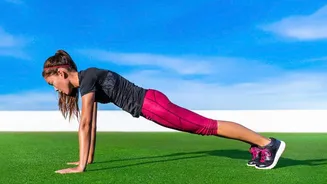
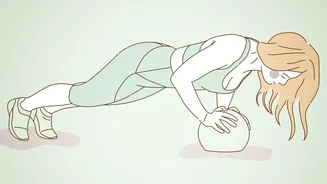
The plank is an isometric exercise that is incredibly effective for building core strength and stability, which helps protect your back and improve posture. To perform a plank, get into a position similar to the top of a push-up, with your hands directly under your shoulders. You can also perform a plank on your forearms for a different challenge. Engage your abdominal muscles and glutes to keep your body in a straight line from your head to your heels. Avoid letting your hips sag or rise too high. The goal is to hold this position. Start by aiming for 20-30 seconds and gradually increase the time as you get stronger. The plank works multiple muscle groups at once, making it a very efficient exercise.
The Powerful Glute Bridge
The glute bridge is a fantastic exercise for activating and strengthening your glutes and hamstrings, which are often underused in a sedentary lifestyle. Lie on your back with your knees bent, feet flat on the floor about hip-width apart, and your arms by your sides with your palms down. Your heels should be a few inches from your glutes. Engage your core and squeeze your glutes as you lift your hips off the floor until your body forms a straight line from your shoulders to your knees. Hold the position for a moment at the top, focusing on the contraction in your glutes, before slowly lowering your hips back to the starting position. This move helps improve hip stability and can alleviate pressure on the lower back.
Putting It All Together
Consistency is more important than intensity when you are just starting out. A good starting point is to create a simple full-body routine that you can perform three times a week on non-consecutive days, allowing for recovery. For each exercise, aim for 2-3 sets of 10-15 repetitions. For planks, hold for 20-30 seconds. A sample beginner routine could look like this: a light warm-up (like marching in place), followed by sets of squats, incline or knee push-ups, glute bridges, and finishing with a plank hold. Listen to your body and focus on maintaining proper form. As you get stronger, you can increase the number of reps and sets, or progress to more challenging variations of these exercises.