

A Whirlwind on the Sun
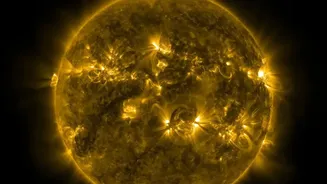
In a groundbreaking discovery, scientists using the world's largest solar telescope have observed tiny, previously unseen whirlpools of plasma on the sun's surface. These swirling vortices, some as small as 20 kilometres wide, are the visual signature
of a phenomenon known as Kelvin-Helmholtz instability (KHI). While this effect is common in nature—seen in breaking ocean waves and cloud formations on Earth—its direct observation on the sun's surface is a first. These are not the slow, leisurely waves one might imagine; they are born from the friction between layers of plasma moving at different speeds, creating a shear force that whips the plasma into spiralling patterns.
A New Eye on the Sun
These unprecedented images were captured by the Daniel K. Inouye Solar Telescope in Hawaii, a marvel of modern astronomy. Its massive four-metre mirror allows for a level of detail that was previously impossible, resolving features on the sun's surface with stunning clarity. The achievement has been compared to discerning a tiny detail on a coin from many kilometres away. By combining these high-resolution observations with sophisticated computer simulations, researchers were able to confirm that these tiny, swirling structures were indeed the long-theorised Kelvin-Helmholtz instabilities. This breakthrough provides a new window into the incredibly dynamic and complex environment of the sun's photosphere, the visible surface where most of its light is emitted.
Braiding Magnetic Fields
The discovery of these plasma waves does more than just add another fascinating phenomenon to the solar catalogue; it begins to answer some of the biggest questions in solar physics. Scientists have long known that the sun's explosive events, like solar flares and coronal mass ejections (CMEs), are driven by its powerful and chaotic magnetic fields. It is believed that energy builds up when magnetic field lines twist around each other like braided hair, eventually snapping and releasing a tremendous amount of energy. What wasn't clear is what causes this twisting in the first place. These newly seen vortices are now a prime suspect. The swirling motions could be the very mechanism that braids the magnetic field lines, loading them with the energy that fuels solar explosions.
The Mystery of a Hot Atmosphere
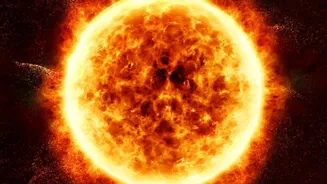
Another long-standing solar puzzle is the coronal heating problem: why is the sun's outer atmosphere, the corona, heated to millions of degrees Celsius while its surface is a comparatively cool 6,000 degrees? The discovery of these plasma waves offers a potential solution. The instabilities could cause energy to cascade into smaller and smaller scales, where it eventually dissipates as heat. This process might provide the extra energy needed to superheat the corona. If proven, it would solve a mystery that has puzzled astrophysicists for more than half a century.
Why Solar Waves Matter on Earth
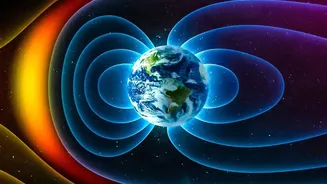
Understanding the sun's behaviour is not just an academic exercise. The explosive events powered by these magnetic processes create what is known as space weather. Coronal mass ejections and solar flares can send vast clouds of charged particles and radiation hurtling towards Earth. These solar storms can have serious consequences, disrupting radio communications, damaging satellites, and even taking down entire power grids. By better understanding the fundamental physics that drive these events, including the role of these newly seen plasma waves, scientists hope to improve their ability to forecast space weather. This would give us more time to protect the vital technologies that underpin modern society, from GPS navigation to global communication networks.