

The Standard Cosmic Story
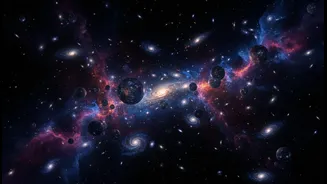
The prevailing theory of cosmic evolution is known as the Lambda-CDM model, and it tells a story of gradual growth. According to this model, after the Big Bang, tiny fluctuations in matter began to clump together, pulled by the gravity of invisible dark
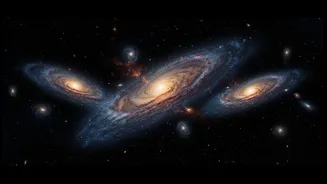
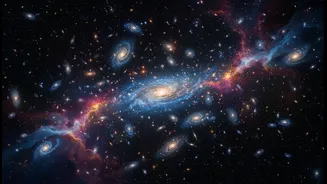
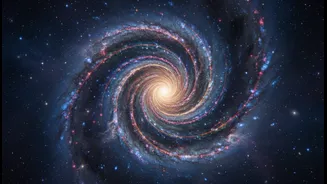
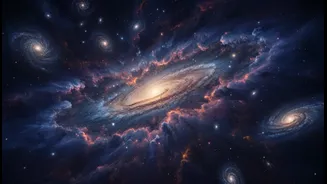
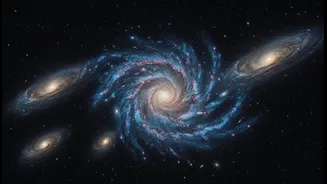
matter. This process, called hierarchical formation, is a 'bottom-up' approach: small structures form first, like tiny streams. Over billions of years, these streams merge to become rivers, and the rivers converge to form mighty oceans—or, in cosmic terms, small proto-galaxies merge to create massive, mature galaxies like our Milky Way. This patient, building-block process has been the bedrock of cosmology, predicting that the early universe should be filled with small, young, and relatively simple 'baby' galaxies.
A Twist in the Tale
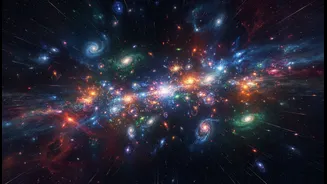
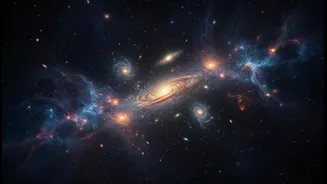
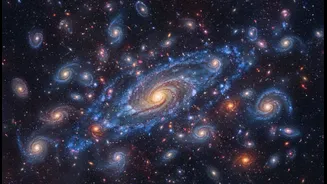
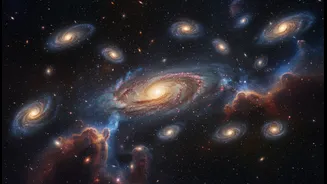
Then, the James Webb Space Telescope (JWST) opened its powerful infrared eyes and peered into the cosmic dawn. What it found has sent shockwaves through the astronomical community. Scientists are discovering galaxies that existed a mere 500 to 700 million years after the Big Bang—a time when the universe was just 3-5% of its current age. The shocking part isn't just that they exist, but their size and maturity. These aren't the 'baby' galaxies everyone expected. Instead, they are shockingly massive and complex, with some appearing as mature as our own galaxy, which had billions more years to develop. Researchers have informally dubbed these objects 'universe breakers' because their existence seems to defy the established timeline.
Why These Giants Break the Rules
The discovery of these colossal early galaxies presents a fundamental problem: there simply wasn't enough time. The standard hierarchical model is a slow-and-steady process. For a galaxy to grow to the size of the Milky Way through countless mergers of smaller systems would take many billions of years. Finding galaxies that are already huge so early on is like finding a full-grown oak tree in a field where you only planted a seed a week ago. The observations suggest that either star formation in the early universe was far more efficient than previously thought, or the underlying framework of cosmic assembly needs a major revision. Some of the galaxies are so massive they challenge the very idea that enough matter could have possibly gathered in one place so quickly.
The Hunt for a New Explanation
This cosmic conundrum has sparked a frenzy of new ideas and has prompted scientists to reconsider theories that were once on the fringe. One possibility is that the early universe was much better at converting gas into stars than it is today, allowing for rapid, explosive growth spurts. Another line of inquiry revisits the nature of dark matter itself, questioning if its properties are different from what we assume. Some researchers even suggest that our theory of gravity might need modification. What this discovery has made clear is that our understanding of the universe's formative years is incomplete. We are missing a key piece of the puzzle that explains this accelerated growth.
What Happens Next in Cosmology
This is not a crisis for science, but rather science in action. The anomalies seen by the JWST are precisely the kind of discoveries it was built to make. The next steps involve gathering more data. Astronomers will use the telescope's spectroscopic instruments to confirm the distances and masses of these 'impossible' galaxies and determine their chemical composition. This will help them understand if these objects are truly galaxies or perhaps something even more exotic, like obscured supermassive black holes. Every new image and data point will serve as a clue, helping theorists refine their models or perhaps build an entirely new one from the ground up, rewriting our origin story one galaxy at a time.