



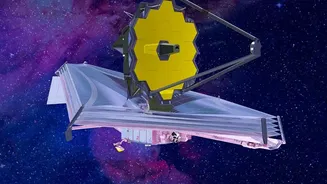
Seeing the Invisible: The Power of Infrared
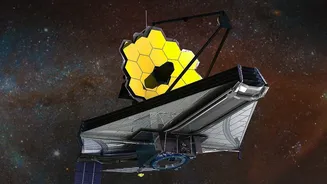
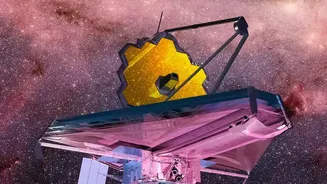
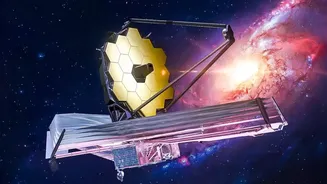
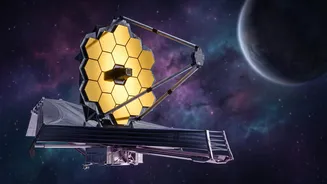
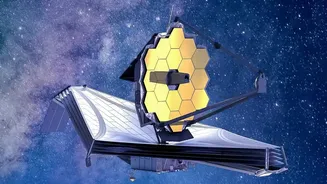
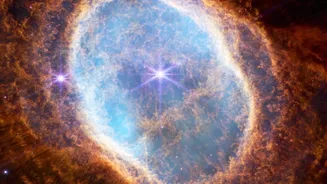
To understand how the JWST decodes alien atmospheres, we first need to appreciate its superpower: seeing in infrared light. Unlike visible light, which our eyes can detect, infrared is a range of light that is often felt as heat. Stars and the planets
that orbit them are incredibly distant, and the light they emit becomes stretched out as it travels across the universe, shifting it into the infrared spectrum. Furthermore, many chemical molecules, including key indicators of life like water and methane, leave unique chemical fingerprints by absorbing specific wavelengths of infrared light. Space telescopes are crucial because Earth's own atmosphere can block or distort the very wavelengths astronomers need to measure. By operating in space and focusing on infrared, JWST can see what other telescopes, like Hubble, could not.
Webb’s Toolkit for Cosmic Chemistry
The JWST isn't just one telescope; it's a suite of four highly advanced scientific instruments, each playing a vital role. For studying exoplanets, two are particularly important: the Near-Infrared Spectrograph (NIRSpec) and the Mid-Infrared Instrument (MIRI). These aren't cameras in the traditional sense. They are spectrographs, which act like cosmic prisms, splitting the faint light from distant stars into a full spectrum of colours. This allows scientists to see which specific wavelengths of light are missing. NIRSpec is a workhorse, capable of observing up to 200 targets at once, while MIRI is uniquely designed to see longer mid-infrared waves, which can penetrate through cosmic dust clouds that might otherwise obscure a planet.
The Transit Method: A Planet's Shadow
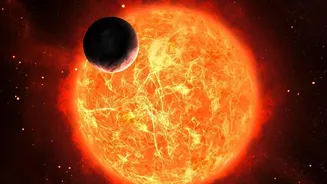
So, how do these instruments get a sample of an alien atmosphere? They use a technique called transit spectroscopy. Scientists wait for a distant planet, or exoplanet, to pass in front of its host star from our point of view—an event known as a 'transit'. As the planet transits, a tiny fraction of the starlight filters through the edge of the planet's atmosphere before it reaches the telescope. The gases in that atmosphere absorb some of the starlight. By comparing the spectrum of the star's light before the transit to the spectrum during the transit, astronomers can identify exactly which wavelengths were absorbed. This reveals a chemical fingerprint, telling them which molecules, such as water vapour, carbon dioxide, or methane, are present.
Groundbreaking Discoveries So Far
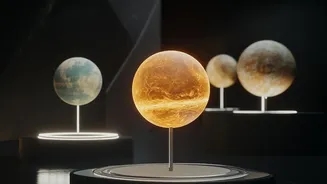
This technique has already yielded incredible results. The JWST has provided the first clear detection of carbon dioxide in an exoplanet's atmosphere on the 'hot Saturn' known as WASP-39 b. It also delivered a full menu of atoms and molecules for that same world, including water, sulphur dioxide, and sodium. More tantalizingly, recent observations of the super-Earth K2-18 b, a potential 'Hycean' (hot ocean) world, have confirmed the presence of carbon-bearing molecules and water vapour, strengthening its case as a world of interest in the search for habitable environments. These aren't just abstract chemical detections; they are clues about a planet's formation, its climate, and its potential to support life. Even the detection of an enormous, evaporating helium cloud around the planet WASP-107b provides vital insights into how planetary atmospheres evolve over time.