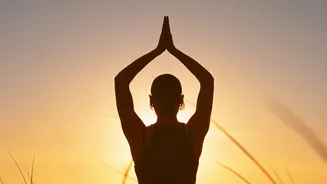







In our perpetually busy lives, true rest feels like a luxury. But what if profound relaxation could be a daily practice? Yoga Nidra, or 'yogic sleep', offers a simple yet powerful way to manage stress and restore your energy.
What Is Yogic Sleep?
Despite its name, Yoga Nidra
isn't about physical postures or stretching. It is a systematic, guided meditation practice typically done while lying down comfortably in Savasana (corpse pose). The goal is to enter a state of deep conscious relaxation, somewhere between waking and sleeping. A guide's voice leads you through a series of steps, including body scanning, breath awareness, and visualisation, to help you withdraw from your senses and turn your awareness inward. This process allows your body to achieve a level of rest that is often deeper and more restorative than conventional sleep, all while the mind remains aware.
The Science of Deep Rest
The magic of Yoga Nidra lies in its effect on the autonomic nervous system. The practice is designed to shift the body from the 'fight-or-flight' sympathetic nervous system response, which is often overactive due to chronic stress, to the 'rest-and-digest' parasympathetic state. Studies suggest that this shift can lead to a reduction in cortisol, the body's primary stress hormone. As you follow the guided instructions, your brainwave activity begins to slow down, moving from the alert beta state to the more relaxed alpha state, and then into the theta state, which is associated with deep meditation and the threshold of sleep. For some, it can even induce delta waves, the hallmark of deep, dreamless sleep, leading to profound rejuvenation.
Easier Than Traditional Meditation?
Many people who struggle with traditional seated meditation find Yoga Nidra more accessible. The primary difference is that meditation often requires you to focus your mind and gently bring it back when it wanders, which can be challenging. Yoga Nidra, on the other hand, is a passive practice where you simply follow a voice. There's no pressure to 'empty your mind' or sit perfectly still. Lying down removes physical discomfort as a barrier, and the guided structure gives the wandering mind an anchor to hold onto. This makes it an excellent entry point for anyone new to mindfulness or for those who find sitting in silence difficult.
How to Start Your Practice
Getting started with Yoga Nidra is simple. All you need is a quiet, comfortable place where you won't be disturbed for 15 to 30 minutes. Lie on your back on a yoga mat or even in your bed. Use a pillow under your head and perhaps a bolster under your knees for lower back support. Cover yourself with a blanket, as your body temperature may drop as you relax. You can find countless free guided Yoga Nidra sessions on platforms like YouTube and various meditation apps. Simply put on your headphones, press play, and allow yourself to follow the instructions without any expectation. The only 'work' is to remain aware and listen.
Fitting It Into a Busy Day
The phrase 'daily movement' doesn't just refer to exercise; it includes the rhythm of our entire day. Yoga Nidra can be seamlessly woven into this rhythm. Feeling a midndertnoon slump at work? A 10ndminute guided practice can be more refreshing than a cup of coffee. Use it as a coolndown after a workout to help your muscles recover and your nervous system settle. It's also a powerful tool for combating insomnia; practicing in bed can help quiet a racing mind and ease you into natural sleep. The key is to see it not as another task to check off, but as a deliberate pause—a gift of deep rest you give yourself whenever you need it most.