





The Problem with Perfect Sunshine
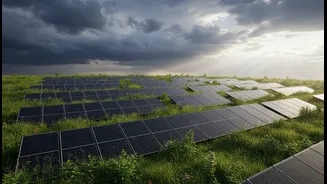
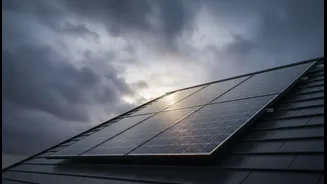
Traditional solar panels, typically made from rigid silicon, are at their best when soaking up direct, bright sunlight. While they do generate some power from the diffuse light that penetrates cloud cover, their efficiency drops significantly. On a heavily
overcast day, a standard panel might only produce 10-25% of its rated output. This limitation is a major hurdle for solar adoption in regions with frequent cloudy weather, such as much of Europe or during India's extensive monsoon season. For solar energy to become a truly universal and reliable power source, it needs to work well even when the sun isn't perfectly shining.
A Breakthrough in Material Science
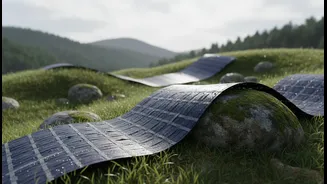
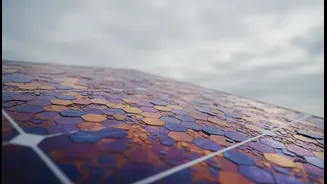
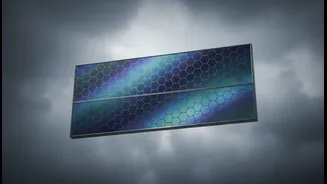
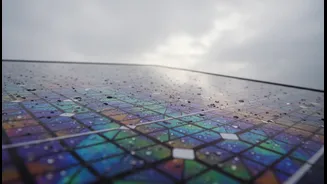
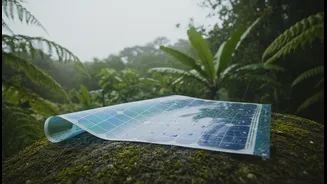
Enter the next generation of solar technology: ultra-thin, flexible materials. Two types are leading the charge: organic photovoltaics (OPV) and perovskites. Unlike thick and brittle silicon, these materials can be made into films thinner than a human hair. Organic solar cells use carbon-based polymers, which are light, versatile, and can be produced through printing techniques. Perovskites are a class of materials with a specific crystal structure that is exceptionally good at absorbing light. Both technologies share a key advantage: they are not only incredibly lightweight and flexible but also have a unique ability to absorb a wider spectrum of light, including the indirect, scattered light that dominates on a cloudy day.
How They Conquer the Clouds
The secret to their low-light performance lies in their molecular and structural properties. Many of these new materials are specifically engineered to be more sensitive to the wavelengths of light that are prevalent in ambient or diffuse conditions, like indoors or under cloud cover. For instance, some organic materials are designed to absorb near-infrared light which penetrates clouds more easily. Similarly, perovskite cells have demonstrated a remarkable ability to generate power efficiently even from indirect light, making them ideal for urban environments where buildings often create shade. Research has focused on stacking different layers, each optimized for a different part of the light spectrum, to maximize absorption no matter the conditions. This multi-pronged approach is fundamentally different from traditional panels that are heavily reliant on direct, high-energy sunlight.
A Game-Changer for India's Solar Goals
For a country like India with ambitious solar energy targets, this technology could be transformative. The annual monsoon, while vital for agriculture, poses a significant challenge for the nation's solar farms, leading to a major dip in energy production for months. A technology that maintains higher efficiency during these overcast months would make the power grid more stable and predictable. Furthermore, the lightweight and flexible nature of these new materials opens up a world of possibilities beyond rigid rooftop panels. Imagine solar-generating films applied to windows, vehicle surfaces, tents for disaster relief, or even integrated into clothing and backpacks to power small devices on the go. This versatility could bring power to remote areas and applications where traditional solar is simply not practical.
From the Lab to the Real World
While the promise is immense, there are still hurdles to overcome before you can coat your windows with a solar film. Researchers are working to improve the long-term durability and stability of these materials, as some early versions were sensitive to moisture and heat. The other major challenge is scaling up manufacturing to bring down costs. While the raw materials for perovskites and organic cells can be cheaper than silicon, establishing new large-scale production processes takes time and investment. Still, progress is rapid. Efficiencies for these new cells have been climbing dramatically in laboratory settings, with some research teams already demonstrating performance that rivals or even exceeds traditional silicon in certain conditions. The path from the lab to commercial viability is becoming clearer every day.