


The Orbital Junkyard
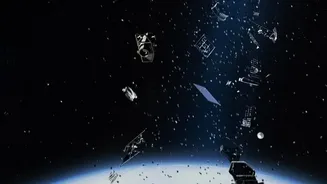
Low Earth Orbit has a garbage problem. For decades, every rocket launch and satellite deployment has left something behind. Today, hundreds of thousands of trackable objects—from defunct satellites the size of a bus to fragments as small as a marble—are
circling the planet at speeds of up to 28,000 kilometres per hour. At these velocities, even a tiny piece of debris can strike a functional satellite or spacecraft with the force of a hand grenade, causing catastrophic damage. This growing cloud of junk poses a severe risk to our global infrastructure, which relies on satellites for everything from GPS and weather forecasting to global communications. Experts warn of a potential chain reaction, known as the Kessler Syndrome, where collisions create more debris, leading to more collisions, rendering key orbits unusable.
Harpoons and Lasers: A Tale of Two Technologies
The headline-grabbing term "laser harpoon" merges two distinct but equally fascinating technologies being developed to tackle space waste. While a literal harpoon made of light remains in the realm of science fiction, agencies and private companies are pursuing two separate and promising paths: physical harpoons to spear large targets and powerful lasers to nudge debris off its course. One is a contact sport, relying on brute force and precision aim, while the other is a contactless method that uses the fundamental principles of physics to gently push junk towards its demise. Both represent a critical shift from passively tracking debris to actively removing it.
The Harpoon: A Modern Take on an Ancient Tool
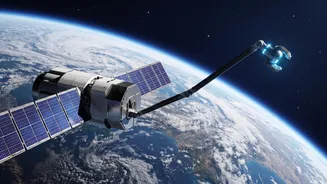
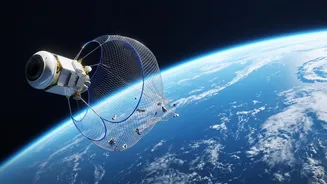
The European Space Agency (ESA) and its partners have taken inspiration from an ancient fishing tool to solve a modern problem. The concept is straightforward: a 'chaser' satellite approaches a large piece of debris, like a dead satellite, and fires a tethered harpoon into it. Once embedded, barbs deploy to secure the target, allowing the chaser to either tow the junk into a lower orbit where it will burn up upon re-entry, or attach a propulsion system to guide its descent. The RemoveDEBRIS mission, led by the Surrey Space Centre and co-funded by the European Union, successfully tested this technology in orbit. In the experiment, a harpoon fired at 20 meters per second successfully penetrated a target panel, proving the viability of the concept in a zero-gravity environment. Airbus Defence and Space, which designed the harpoon, is continuing to refine the system for future missions.
The Laser: Nudging Debris with Light
The second approach, known as laser ablation, is more subtle but just as effective. This method involves firing a powerful, focused laser beam—either from the ground or a space-based platform—at a piece of debris. The intense energy doesn't destroy the object, but instead vaporizes a tiny amount of its surface material. This creates a small jet of plasma, which acts like a micro-thruster, generating a gentle push. By repeatedly 'nudging' the object with laser pulses, its orbit can be gradually altered, forcing it onto a trajectory that will cause it to re-enter and disintegrate in Earth's atmosphere. This contactless method is seen as ideal for dealing with smaller or irregularly shaped objects that may be difficult to capture with a net or harpoon. Researchers are developing complex algorithms to control networks of lasers for efficiently targeting multiple pieces of debris.
The Missions Leading the Cleanup
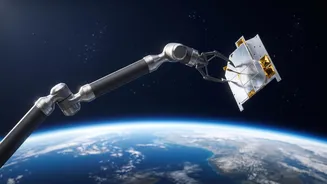
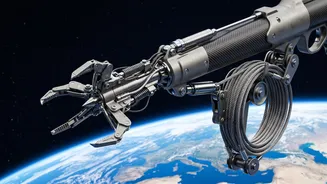
Several key missions are paving the way for a commercial debris removal industry. The ESA's ClearSpace-1 mission, scheduled to launch around 2028, will be one of the first to remove an existing piece of space junk from orbit. Led by Swiss startup ClearSpace SA, the mission will target a defunct ESA satellite, using a set of four robotic arms to capture it before guiding both craft to a fiery end in the atmosphere. Meanwhile, the Japanese space agency, JAXA, is working with the company Astroscale on its own debris removal demonstrations. Astroscale's ADRAS-J mission has already successfully rendezvoused with and inspected a large piece of a spent rocket, a crucial first step toward eventually capturing and de-orbiting it. These missions are not just about testing technology; they are about creating a sustainable, long-term market for in-orbit services.