







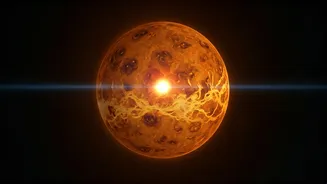


The Planet That Spins the Wrong Way
Before we get to the new discovery, let's set the stage. Venus is a planetary oddball. On almost every other planet in our solar system, including Earth, the sun rises in the east and sets in the west. On Venus, it’s the opposite. This is because Venus spins
backwards, a phenomenon known as retrograde rotation. Not only that, but it spins incredibly slowly. A single day on Venus (one full rotation) lasts for 243 Earth days, which is actually longer than its year (the time it takes to orbit the sun, about 225 Earth days). For decades, scientists have tried to understand why Venus is so different. Is it the result of a colossal ancient impact that flipped it over? Or is it due to the drag from its incredibly thick, heavy atmosphere acting like a brake over billions of years? The mystery only adds to the planet's allure.
The 'Astounding Fact' Unveiled
For years, the exact length of a Venusian day was a subject of debate, with estimates varying by several minutes. Now, a groundbreaking study has given us the most precise measurement ever, and it came with a shocking revelation: there is no single, fixed length for a day on Venus. A team of scientists, led by researchers from UCLA, found that the planet’s rotation speed is constantly changing. The length of a day can vary by as much as 20 minutes from one measurement to the next. The primary culprit is believed to be Venus’s soupy, dense atmosphere. As this massive ocean of gas sloshes around the planet, it pushes and pulls on the surface, minutely speeding up and slowing down its rotation. Imagine trying to spin a ball that's covered in a thick layer of honey; the drag would be immense and uneven. That's essentially what's happening on a planetary scale.
Listening to a Planet's Wobble
So how did scientists figure this out with such precision? They essentially played a game of cosmic pitch-and-catch for 15 years. From 2006 to 2020, they used the powerful Goldstone Solar System Radar in California to bounce radio signals off Venus’s surface. They then received the faint echo of those signals at the Green Bank Observatory in West Virginia. By analysing the subtle changes in the returning signal, they could measure the planet’s spin down to a few parts per million. This technique allowed them to track not just the speed but also the subtle wobble of Venus’s axis, a movement known as precession. They found that Venus is tilted by a mere 2.64 degrees (compared to Earth's 23.5 degrees), but its axis slowly traces a circle in the sky every 29,000 years, a surprisingly similar timeframe to Earth’s own precession cycle.
Why This Changes Everything We Know
This isn't just a quirky piece of planetary trivia. These precise measurements act like a planetary-scale X-ray, allowing us to peer inside Venus for the first time. The way a planet spins and wobbles is directly influenced by what it's made of and how that material is distributed. Based on how Venus’s spin responds to the atmospheric drag and how its axis precesses, the scientists were able to calculate the size of its core. The data strongly suggests Venus has a core about 7,000 kilometres in diameter, similar in size to Earth's. Crucially, the data also implies that the core must be liquid. If it were solid, the planet would respond differently to these external forces. This is a monumental finding, as it helps explain the planet’s internal structure without ever landing a probe to drill through its hellish crust.