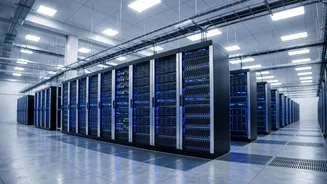






The rise of Artificial Intelligence is not just happening on our screens; it's being built into the very foundations of India's digital economy. A new forecast from Crisil Ratings confirms this, projecting a massive expansion in data centres.
An Investment Supercycle
According
to a recent report by Crisil Ratings, India's data centre industry is poised for a five-fold capacity increase, projected to reach 7.5 gigawatts (GW) by March 2030. This explosive growth is expected to attract investments exceeding Rs 3 lakh crore over the next four financial years. The rating agency describes this phase as an 'investment supercycle', primarily fuelled by the immense computational needs of generative artificial intelligence (GenAI), alongside broader enterprise digitalisation and a surge in data consumption across the country.
The AI and Cloud Catalysts
At the heart of this boom is the unprecedented demand from AI and cloud computing. Training and running advanced AI models, especially GenAI, requires enormous processing power, which in turn consumes vast amounts of electricity and needs specialised cooling. This has fundamentally changed the economics and design of data centres, which are now being built to handle much higher power densities. The demand is so strong that existing facilities in India are running at about 90% utilisation. Furthermore, over 95% of the capacity currently under construction is already contracted, largely to hyperscale cloud providers who serve as the backbone for AI services.
India's Cost Advantage
India holds a significant competitive edge that makes it an attractive destination for these massive investments. According to Crisil, development costs for data centres in India are approximately 20% lower than in competing Asia-Pacific markets. This is attributed to more competitive costs for land, construction, and labour. When combined with lower power tariffs, it results in rental rates for data centre space that are 30-35% lower than in peer markets. This cost-effectiveness is a powerful magnet for global hyperscalers, who are increasingly looking to India to build out their infrastructure, not just for the domestic market but for international clients as well.
Emerging Hubs and Power Challenges
While Mumbai and Chennai have traditionally dominated India's data centre landscape, the next wave of growth is becoming more geographically diverse. The Crisil report highlights that about three-fourths of the upcoming 6 GW of capacity is expected to be concentrated in Visakhapatnam, Mumbai, and Hyderabad. However, this unprecedented expansion brings a critical challenge: power. By 2030, the data centre capacity in these cities could represent a significant portion of their current peak power demand—around 80% in Visakhapatnam and 60% in Mumbai. This makes timely grid connectivity and augmenting power transmission infrastructure a crucial factor for the sector's success.
The Road Ahead
The path to 7.5 GW is paved with both opportunity and risk. The reliance on hyperscalers, which are expected to lease 75–80% of India’s capacity by 2030, creates a customer concentration risk for developers. While long–term contracts of $15–$20$ years provide strong revenue visibility, the immense bargaining power of these few large clients could eventually put pressure on rental prices. For India, successfully navigating this build–out is fundamental. It supports the 'Digital India' mission, enables data localisation, and solidifies the nation’s role as a critical hub in the global technology ecosystem. The race to build the infrastructure for the AI era is on, and India is positioning itself as a leading contender.