


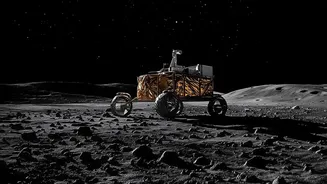

The Moon’s Prime Real Estate
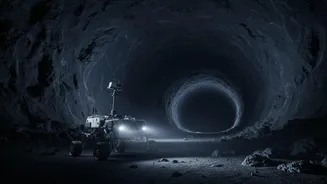
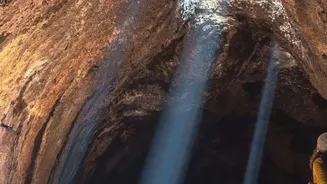
Billions of years ago, rivers of lava flowed across the Moon. As the top layer of this lava cooled and hardened, the molten rock underneath continued to flow, eventually draining away to leave behind vast, hollow tunnels. These lunar lava tubes, some
potentially large enough to house entire cities, are now considered the most promising sites for future human habitats. Why? Because they offer a ready-made solution to the Moon's biggest dangers. The lunar surface is a hostile environment, bombarded by cosmic radiation and micrometeorites, with temperatures swinging wildly from a scorching 127°C during the day to a frigid -173°C at night. Inside a lava tube, however, the temperature is a stable and comparatively mild -20°C, and the thick rock ceiling provides natural, effective shielding from radiation and impacts. These subterranean caverns, revealed by collapsed sections called 'skylights', are no longer just a theory; orbital radar data confirmed the first accessible lava tube in 2024, igniting a new wave of interest in exploring them.
Why We Need Robotic Cave Explorers
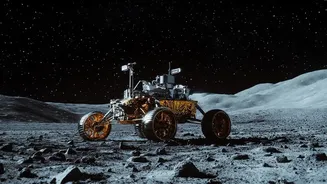
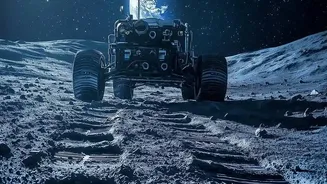
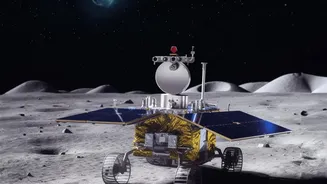
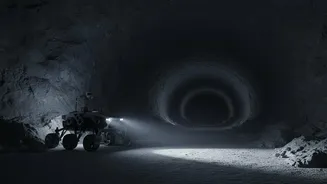
Before astronauts can move in, we need to know what we're getting into. Are these tubes structurally sound? Do they contain valuable resources like water ice? What does the terrain look like? Sending humans to find out is far too risky, which is why a new generation of robotic explorers is being designed specifically for the task. These aren't your standard wheeled rovers built for flat surfaces. Exploring a cave on the Moon requires navigating treacherous, dark, and unknown environments without direct human control. The signal delay from Earth makes real-time driving impossible, so these rovers must be highly autonomous, capable of making their own decisions to avoid obstacles and map their surroundings in 3D. Power is another huge hurdle; without sunlight, solar panels are useless, forcing engineers to devise creative solutions like tethers, advanced batteries, or wireless power transmission from a surface unit.
The Race to Build the Lunar Mapper
Several space agencies and private companies are developing concepts for these specialised machines. The European Space Agency (ESA) has been studying a spherical probe called DAEDALUS, designed to be lowered into a skylight on a tether by a robotic crane. This 46-cm ball is packed with cameras and lidar to create detailed 3D maps as it rolls autonomously through a cave. Meanwhile, NASA's Innovative Advanced Concepts (NIAC) program recently funded a project by Stone Aerospace called LUX, a fascinating drone that would be powered by a laser beamed through its fiber-optic tether from a surface rover. Other concepts include teams of collaborating robots being tested in volcanic caves on Earth and even quadruped 'robot dogs' proposed by Chinese researchers to help with construction tasks inside the tunnels. These projects, currently in prototype and testing phases on Earth, are the critical first step toward turning science fiction into an engineering reality.
From Exploration to Habitation
The data sent back by these robotic pioneers will be invaluable, creating detailed maps that allow scientists to choose the safest and most resource-rich locations for a base. Once a tube is certified as safe, the next phase of construction can begin. Early concepts involve sending autonomous robots to clear and level the floor of a lava tube. Following that, expandable habitats, like the inflatable modules already tested on the International Space Station, could be deployed inside the protective confines of the cave. These structures could be connected to form a sprawling underground research station, shielded from the dangers of the lunar surface. This approach is not only safer but also more sustainable, as it leverages the Moon's own geology for protection, reducing the mass and complexity of the habitats that need to be launched from Earth.