



Our Peculiar Galactic Neighbour
At just 11 to 13 million light-years away, Centaurus A is practically on our cosmic doorstep. Visible from the Southern Hemisphere, it's one of the closest and most studied active galaxies. But its proximity is not what makes it so fascinating. Centaurus A is an astronomical
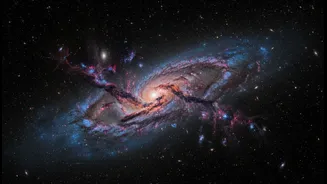
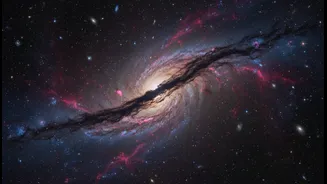
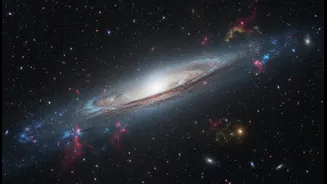
enigma, a beautiful mess born from a cataclysmic collision. At first glance, it looks like a large, smooth elliptical galaxy, but a thick, dark lane of dust cuts dramatically across its bright center. This peculiar feature, first noted in 1847, is the tell-tale sign of the galaxy's violent history. Astronomers now understand that Centaurus A is the result of a merger between a giant elliptical galaxy and a smaller spiral galaxy that it consumed roughly two billion years ago. This collision has left it in a perpetual state of turmoil and activity, making it a perfect natural laboratory for understanding the forces that shape the cosmos.
Webb Lifts the Dusty Veil
For years, that dramatic dust lane has been a source of both fascination and frustration for astronomers. While beautiful, it acts like a thick cosmic curtain, blocking visible light and hiding the secrets of the galaxy's core. Previous observatories like the Hubble Space Telescope could only see its silhouette, while infrared telescopes like Spitzer lacked the sharpness to resolve fine details. Now, new images from the James Webb Space Telescope (JWST), released to mark its fourth anniversary of science operations, have finally pierced that veil. Using its powerful mid-infrared instruments, Webb has provided the most detailed view of Centaurus A ever captured. The images cut through the dust to reveal what was once a grainy glow as a dense field of millions of individual stars, offering an unprecedented look into the galaxy's heart.
Reading the Scars of a Collision
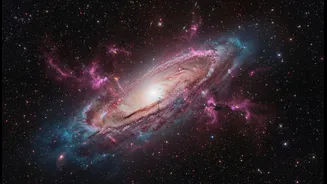
The new Webb images transform Centaurus A into a vivid record of its past. The parallelogram-shaped dust lane, now seen in stunning detail, is revealed to be a warped and churning disk of gas and dust—the raw material for new stars. Within this chaos, Webb has unveiled intricate filaments, glowing clouds of warm dust, and even a mysterious S-shaped structure near the core whose origins are still being debated. By resolving individual stars, astronomers can begin to perform a kind of galactic archaeology. They can distinguish between different generations of stars, helping them map out the galaxy's history and understand how the collision triggered intense bursts of star formation. These new observations provide crucial clues about how galaxies grow and evolve through mergers, a common process throughout the universe's history.
The Monster in the Middle
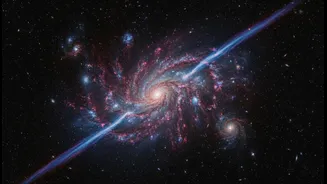
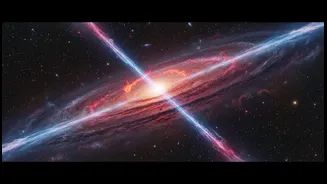
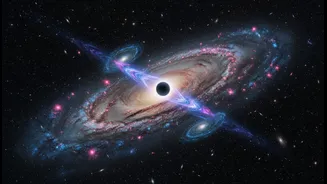
At the heart of all this activity lies a supermassive black hole with the mass of 55 million suns. Unlike the placid black hole at the center of our own Milky Way, the one in Centaurus A is actively feeding on the gas and dust supplied by the galactic merger. As it feasts, it unleashes enormous amounts of energy, launching powerful jets of material from its poles at nearly half the speed of light. These jets, which are invisible to the naked eye but glow brightly in radio and X-ray light, extend for over a million light-years. They slam into the surrounding gas, creating shockwaves that further shape the galaxy. Webb's new data allows scientists to study the motion of gas near the black hole, providing new insights into the complex dance between a black hole's destructive power and its ability to influence the birth of new stars.
A Window to the Universe's Past
The study of Centaurus A is not just about understanding one peculiar galaxy; it is about understanding the fundamental processes that have shaped our universe. Because it is so close and so active, it serves as an invaluable model for what is happening in more distant galaxies that our telescopes cannot resolve in such detail. The epic collision, the subsequent burst of star formation, and the activity of the central supermassive black hole are all events that were common in the early universe. By studying Centaurus A, astronomers are essentially looking at a local example of cosmic history. Each new layer of detail uncovered by the James Webb Space Telescope helps us piece together the grand narrative of how galaxies like our own came to be, offering a glimpse into the chaotic, violent, and ultimately creative history of the cosmos.