





1. Gentle Neck Tilts
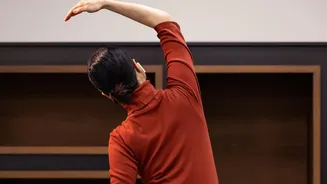
Neck stiffness is a common complaint for office workers. To gently release this tension, sit up straight with your feet flat on the floor. Slowly tilt your right ear toward your right shoulder until you feel a light stretch. It is crucial not to pull
your head down or force the movement. Hold for 15 to 20 seconds, breathing calmly, then slowly return to the center. Repeat on the left side. This movement helps lengthen the muscles along the side of your neck that tighten from staring at a screen.
2. Seated Spinal Twist
A tight back is the hallmark of a long day spent sitting. A gentle twist can help improve spinal mobility. Sit tall at the edge of your chair. While keeping your hips facing forward, slowly rotate your upper body to the right. You can place your left hand on the outside of your right thigh for a mild assist. Only twist as far as feels comfortable. Hold for 15 seconds, then repeat on the other side. This mobilizes the thoracic spine, or mid-back, which often gets rigid.
3. Mindful Shoulder Rolls
We often hold stress in our shoulders, causing them to hunch forward. To counteract this, sit or stand tall. Inhale and lift your shoulders up toward your ears, then exhale and roll them back and down. Imagine you are trying to squeeze your shoulder blades together. Do this slowly for five to ten repetitions, then reverse the direction, rolling your shoulders forward. This simple movement helps release tension in the upper trapezius muscles and resets your posture.
4. Seated Cat-Cow
This yoga-inspired move is excellent for waking up a stiff spine. Sit with your hands on your knees and feet flat on the floor. On an inhale, gently arch your back, open your chest, and look slightly upward (Cow pose). As you exhale, round your spine, drop your chin to your chest, and let your back curve (Cat pose). Alternate between these two positions slowly for about a minute. The focus is on smooth, controlled movement, not extreme bending.
5. Wrist and Finger Extensors
Hours of typing and mouse use can lead to strained forearms and wrists. To stretch them, extend your right arm in front of you with your palm facing down. With your left hand, gently bend your right fingers back toward your body until you feel a stretch in your forearm. Hold for 15 to 20 seconds without forcing it. Release, then point the fingers toward the floor and gently pull them toward you for a different stretch. Repeat with your left arm.
6. Seated Figure-Four Stretch
Prolonged sitting tightens the hip and glute muscles, which can contribute to lower back pain. To address this, sit on the edge of your chair and cross your right ankle over your left knee, creating a '4' shape. Keep your back straight and gently lean forward from your hips until you feel a stretch in your right glute and hip. Stop as soon as you feel a comfortable tension. Hold for 20 to 30 seconds, then switch sides. This helps open up the hip joints.
7. Thoracic Extension Over Chair
This stretch counteracts the hunching posture many adopt at their desks. Sit tall and place your hands behind your head, elbows wide. Keeping your lower back stable, gently lean your upper back over the top of your chair, allowing your chest to open up. Look forward, not up at the ceiling, to avoid straining your neck. Hold this extension for a few deep breaths, then return to the starting position. This movement helps restore mobility to your mid-back.