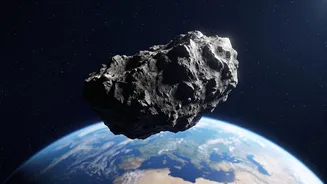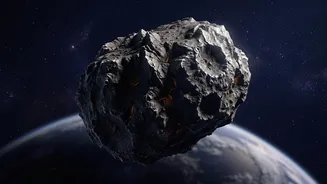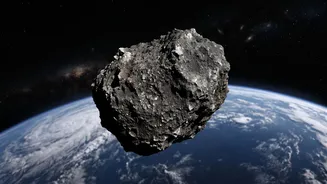







In the vastness of space, a tiny object named 1998 KY26 is causing a big stir. It's one of the fastest-spinning objects ever seen and has a strange acceleration that puzzles scientists. Now, new thermal modelling is peeling back its secrets.
A Rock in a Cosmic Hurry
Meet 1998
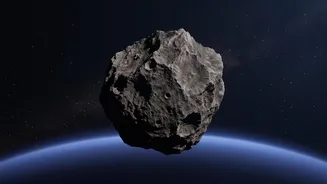
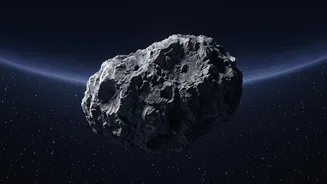
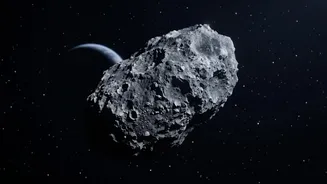
KY26, an asteroid that is anything but ordinary. Discovered in 1998, this near-Earth object is remarkably small, measuring only about 11 metres in diameter—roughly the size of a delivery truck. What truly sets it apart is its astonishing speed of rotation. A 'day' on 1998 KY26 lasts just 5.35 minutes, meaning it completes a full spin in the time it takes to listen to a couple of songs. This rotation is so rapid that it pushes the limits of what an object can withstand before flying apart. Most asteroids of this size are thought to be loose collections of rubble, but such a fast spin suggests 1998 KY26 might be a single, solid piece of rock. Adding to the mystery is its unusual brightness and a strange acceleration that cannot be explained by gravity alone, leading to intense scientific curiosity.
Reading an Asteroid's Temperature
To solve the puzzle of 1998 KY26, scientists have turned to a technique called thermal modelling. Think of it like taking an object's temperature from millions of kilometres away. By observing the infrared heat an asteroid radiates, researchers can deduce its physical properties. How quickly a surface heats up in sunlight and cools down in darkness reveals its 'thermal inertia'. A sandy beach, for instance, has low thermal inertia, heating and cooling rapidly. Solid rock has high thermal inertia, retaining heat for longer. For 1998 KY26, this modelling is crucial. One leading theory for its strange acceleration was that it might be a 'dark comet'—an asteroid hiding pockets of ice that turn to gas and create a tiny, invisible thrust. But ice can only survive if it stays extremely cold. The thermal models were designed to find out if any part of 1998 KY26 is cold enough for ice to last.
What the New Models Revealed
Recent research published in the journal Icarus used sophisticated thermal modelling to simulate temperatures on and inside 1998 KY26. A team from the Georgia Institute of Technology found that the asteroid is likely too warm to hold onto buried ice for long periods. According to their calculations, even the coldest parts of the asteroid average temperatures far above the point where water ice would sublimate, or turn directly into gas, in a vacuum. The model showed that at these temperatures, any significant amount of ice responsible for the asteroid's acceleration would vanish in just a few thousand years, and possibly as quickly as a few decades. While this doesn't completely rule out the presence of some ice, it makes the 'dark comet' theory a much less likely explanation for its mysterious movement.
A Target for the Future
The riddles surrounding 1998 KY26 make it a high-priority target for exploration. Japan's space agency, JAXA, has directed its Hayabusa2 spacecraft, famous for returning samples from the asteroid Ryugu, toward this very object. The spacecraft is scheduled for a rendezvous in July 2031, when 1998 KY26 will become the smallest asteroid ever visited by a probe. The data gathered from the thermal modelling is vital for planning this challenging mission. Understanding the asteroid's surface properties—whether it's solid rock or a rubble pile—and its rapid spin is critical for the Hayabusa2 team to safely approach and study it. This future encounter promises to provide ground truth answers to the questions raised by the models, offering unprecedented insights into planetary defense and the nature of the small, fast moving objects that populate our solar system.