

A Star for the History Books
First observed in Europe on October 9, 1604, the event was meticulously documented by German astronomer Johannes Kepler, which is why it's often called Kepler's Supernova. At its peak, it was visible during the day for over three weeks, challenging the long-held
belief that the heavens were perfect and unchanging. Kepler and his contemporaries, including observers in China and Korea, had no telescopes, relying only on their eyes. They were witnessing the last supernova to be seen in our Milky Way galaxy with the naked eye. What they thought was the birth of a star was actually its violent death, an event that astronomers today can study in incredible detail.
Cosmic Forensics with Modern Telescopes
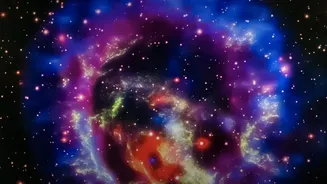
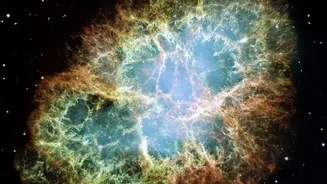
The light from the explosion reached Earth in 1604, but the event itself happened roughly 20,000 light-years away. For centuries, the star's location was just a point in historical records. But in 1941, astronomers pointed modern instruments to the coordinates Kepler noted and found its ghostly after-image: a supernova remnant. Today, we don't just see a faint smudge; powerful space telescopes like NASA's Chandra X-ray Observatory, the Hubble Space Telescope, and the Spitzer Space Telescope can observe the remnant across different wavelengths of light, each revealing a different piece of the puzzle.
X-Rays Reveal a Violent Blast
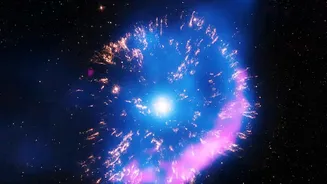
The most intense energy from the explosion's aftermath is invisible to our eyes but shines brightly in X-rays. The Chandra X-ray Observatory has been crucial in studying SN 1604. Its images show a bubble-shaped shroud of gas, heated to millions of degrees, expanding at tremendous speeds. By tracking 'knots' of debris over many years, astronomers have clocked material flying outwards at over 20 million miles per hour. This high-energy view helps scientists understand the power of the initial explosion and how the blast wave interacts with the surrounding interstellar gas.
Infrared and Radio Waves Tell Another Story
While X-rays show the hot, violent action, infrared and radio telescopes tell a different part of the story. Infrared observatories can detect the glow of cosmic dust, including particles forged in the explosion itself and swept up by the expanding shockwave. Meanwhile, radio telescopes map the magnetic fields within the remnant and trace the outer edges of the expanding shell of gas. By combining data from X-ray, infrared, visible, and radio observations, astronomers can build a complete, multi-layered 3D model of what remains of the star.
Unlocking a Cosmic Yardstick
All this forensic work has led to a crucial conclusion: SN 1604 was a Type Ia supernova. This specific type of explosion happens in a binary star system when a dense, compact star called a white dwarf pulls too much material from its companion or merges with another white dwarf. This triggers a runaway thermonuclear explosion. Type Ia supernovae are incredibly important because they all explode with a predictable, uniform brightness, making them 'standard candles'. By comparing how bright they appear to how bright they actually are, astronomers can calculate their distance, a fundamental technique for measuring the scale and expansion of the universe.