




What Exactly Is Shadow Boxing?
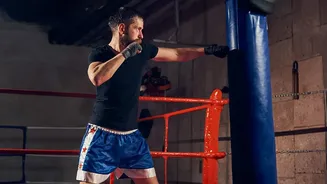
Shadow boxing is a solo training drill where you move, punch, and defend as if you were in a ring with an opponent. But it's far more than just punching the air; it's a full-body workout that demands focus, control, and imagination. The goal isn't to
throw with wild power, but to move with intention, focusing on proper technique, footwork, and rhythm. By visualizing an opponent, you turn what looks like a simple exercise into a dynamic session that sharpens both your body and mind, making it a foundational practice for everyone from beginners to professional fighters. At its core, it's about building muscle memory and coordination.
The Underrated Fitness Benefits
Don't let the lack of equipment fool you; shadow boxing is a powerhouse for physical fitness. It functions as a high-intensity interval workout, spiking your heart rate to improve cardiovascular endurance and burn calories. Every punch, when thrown correctly, is a full-body movement. Power generates from your feet, travels through your core, and extends through your fist, engaging your legs, abs, back, and shoulders all at once. This constant, controlled motion also builds coordination, balance, and agility. Plus, the rhythmic and focused nature of shadow boxing is a fantastic stress reliever, helping to release endorphins and clear your mind.
Your Foundation: Stance and Guard
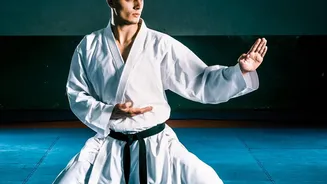
Before you throw a single punch, getting your stance right is critical. Stand with your feet about shoulder-width apart. If you're right-handed, your left foot will be forward (this is called an 'orthodox' stance). Keep your lead foot pointed slightly inward and your rear foot at about a 45-degree angle. Your weight should be evenly distributed, with a slight bend in your knees, staying light on the balls of your feet. Next, your guard. Bring your hands up to your face, with your rear hand near your cheek for protection and your lead hand slightly in front. Keep your elbows tucked in to protect your ribs and your chin slightly down. This position is your home base; you'll return to it after every move.
The Four Basic Punches
Mastering these four punches is your next step. Focus on form, not speed or power. 1. The Jab: This is a quick, straight punch thrown with your lead hand. It’s used to measure distance and set up other punches. Snap it out and bring it back to your guard immediately. 2. The Cross: This is your power punch, thrown with your rear hand. As you punch, pivot your back foot and rotate your hips and torso to generate force. 3. The Hook: A semi-circular punch thrown with either hand, aimed at the side of your imaginary opponent. Bend your arm at roughly a 90-degree angle and use your hip rotation for power. 4. The Uppercut: A short, rising punch thrown with either hand. It’s ideal for close quarters, traveling upward as you dip your knees slightly and drive power from your legs.
Putting It All Together: A Beginner's Workout
A structured routine helps turn random movements into a real workout. Try this simple format using 2rd minute rounds with 1 minute of rest in between, similar to a real boxing match.' Warm-'up (3-'5 minutes): Start with light jogging in place,' arm circles,' and torso twists to get your blood flowing.' Round '1': Footwork & Jabs.' Move around your space using basic footwork—forward,' back,' and side-'to-'side.' Throw only jabs,' focusing on snapping the punch and returning your hand to your guard.' Round '2': Jab & Cross.' Now,' combine the jab and the cross (the '1-'2'' combination).' Throw the combo,' move your feet,' and repeat.' Round '3': Add the Hook.' Practice throwing a jab,' a cross,' and then a lead hook (a '1-'2-'3'' combination).' Focus on the smooth transfer of weight between each punch.' Round '4': Freestyle.' Mix all your punches,' footwork,' and even some defensive head movement like slips (moving your head to the side).' Imagine an opponent and react.' Cool-'down (3-'5 minutes): Walk around slowly,' stretch your shoulders,' chest,' and legs.'