







The Challenge of a Cloudy Day
Conventional solar panels, typically made from silicon, are marvels of modern technology. They capture photons from sunlight and convert them into electricity using the photovoltaic effect. On a clear, sunny day, they are highly effective. However, when
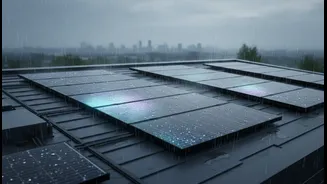
clouds roll in, their performance drops significantly. The thick blanket of clouds scatters and blocks direct sunlight. While panels can still generate some power from this diffused light, their output can fall to just 10-25% of their rated capacity. This variability makes it challenging for grid operators to rely on solar as a consistent power source, especially in regions prone to overcast weather.
Enter the Tandem Cell
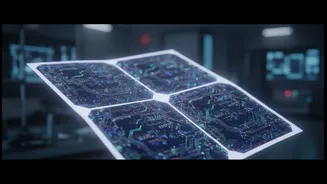
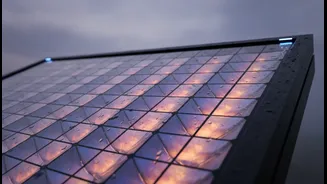
The breakthrough that has researchers excited is a new architecture known as the tandem solar cell. Instead of relying on a single material, this technology stacks two different types of solar cells on top of each other. The most promising combination involves pairing a layer of a material called perovskite on top of a traditional silicon cell. Think of it as a tag team for light absorption. Perovskite is excellent at capturing the high-energy visible light spectrum—the kind of light that is still present even on cloudy days. The lower-energy, near-infrared light that perovskite doesn't absorb passes through to the silicon layer below, which is specifically designed to convert that part of the spectrum into electricity.
A Broader Spectrum of Power
By working together, this dual-layer system can utilise a much broader range of the solar spectrum than silicon can alone. Traditional panels miss out on converting a significant portion of the sun's energy. Tandem cells, by dividing the task, waste less and convert more. This increased efficiency isn't just for sunny days. In low-light or overcast conditions, the ability to effectively capture more of the available diffused light means these panels can generate significantly more power than their conventional counterparts. This could fundamentally change the economics and reliability of solar energy, making it a more robust power source year-round.
A Game-Changer for India’s Energy Ambitions?
For India, which has one of the world's most ambitious solar energy programs, this technology could be transformative. The annual monsoon season, spanning several months, creates a massive dip in solar generation, forcing a reliance on other energy sources. More efficient all-weather panels could smooth out this seasonal volatility, providing more stable power to homes and industries. This would not only enhance the country's energy security but also accelerate its transition away from fossil fuels. By generating more power per square metre, tandem cells could also mean that less land is required for large-scale solar farms, addressing another key challenge in a densely populated nation.
From Lab to Rooftop: The Road Ahead
While the technology is incredibly promising, tandem solar cells are not yet a common sight on rooftops. Researchers are consistently breaking efficiency records in laboratory settings, but the key challenges now are scalability, durability, and cost. Perovskite, the star material, has historically had issues with degrading when exposed to moisture and heat over long periods. However, recent advancements in protective coatings and manufacturing techniques are beginning to overcome these hurdles. The next step is to prove that these panels can be mass-produced at a competitive price and can withstand real-world conditions for 25 years or more, just as conventional panels do. Other futuristic concepts, like 'anti-solar' panels that generate power at night by radiating heat into space, are also being explored, but tandem cells represent the most near-term evolution for mainstream solar power.