



The Cosmic Neighbourhood Watch
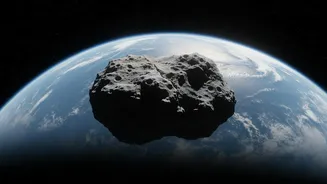
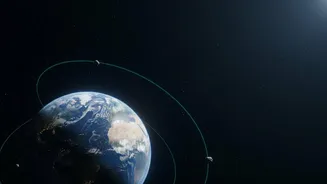
Our solar system is filled with millions of asteroids, ancient rocky remnants from its formation. Most keep a safe distance, but some, known as Near-Earth Objects (NEOs), have orbits that bring them close to our planet. While more than 100 tons of harmless
dust and sand-sized particles hit Earth daily, larger objects pose a genuine risk. An asteroid larger than 30 to 50 metres could cause significant damage if it reached the surface, which is why agencies are so focused on them. The goal of the global planetary defense community is to find these objects, track them, and characterize their size, shape, and composition. This systematic cataloging is the first and most critical step in protecting Earth.
Finding the Needles in a Haystack
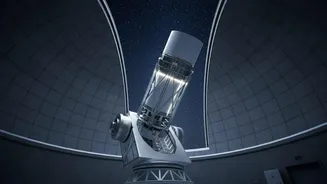
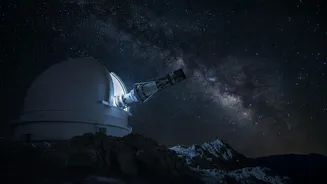
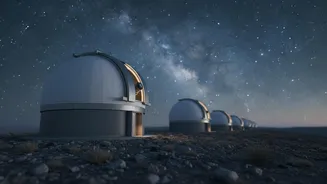
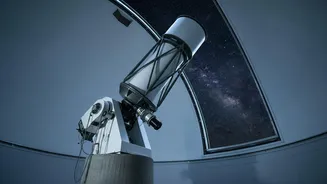
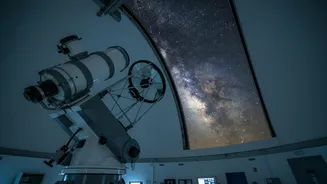
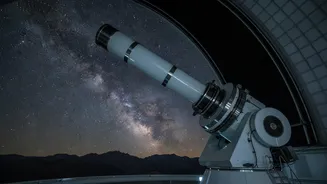
Detecting a potentially hazardous asteroid is a meticulous process. Ground-based telescopes, like those in the Pan-STARRS and Catalina Sky Survey projects, repeatedly image sections of the night sky. By comparing these images, which are taken several minutes apart, astronomers can spot the faint points of light that move against the fixed background of stars. Once a potential NEO is flagged, its data is sent to the Minor Planet Center, the world's clearinghouse for all asteroid observations. From there, organizations like NASA's Center for Near-Earth Object Studies (CNEOS) calculate the object's precise orbit, projecting its path for decades to come to determine any potential impact risk. This relentless surveillance has already identified thousands of NEOs, creating a comprehensive database of our closest cosmic neighbours.
A Global Planetary Defense Team
No single country can guard the planet alone. Planetary defense is a highly collaborative, international effort. In the United States, NASA's Planetary Defense Coordination Office (PDCO), established in 2016, leads the charge. It coordinates the work of finding and tracking NEOs and would lead the U.S. government's response to any credible threat. Globally, these efforts are harmonized through bodies like the International Asteroid Warning Network (IAWN) and the Space Mission Planning Advisory Group (SMPAG), which are endorsed by the United Nations. IAWN connects institutions from around the world to share observation data and issue warnings, ensuring that information about a potential impact is accurate and widely distributed.
From Detection to Deflection
Finding a threatening asteroid is only half the battle; the other half is knowing what to do about it. For years, deflection methods were purely theoretical, but that changed with NASA’s Double Asteroid Redirection Test (DART) mission. In September 2022, the DART spacecraft deliberately slammed into Dimorphos, a small asteroid moonlet. The mission was a resounding success. The impact shortened Dimorphos's orbit around its parent asteroid by 33 minutes, proving that humanity has the technology to alter the path of a celestial body. This “kinetic impactor” technique is now a proven tool in our planetary defense arsenal. The European Space Agency's upcoming Hera mission will visit the Didymos-Dimorphos system to study the aftermath of DART's impact in greater detail, further refining our understanding.
The Future of Watching the Skies
The work is far from over. A congressional mandate tasked NASA with finding 90% of NEOs larger than 140 meters, a goal that requires even more advanced tools. To that end, NASA is developing the NEO Surveyor, a space-based infrared telescope scheduled to launch no earlier than 2027. From its vantage point in space, NEO Surveyor will be able to spot asteroids that are difficult for ground-based telescopes to see, particularly those that approach from the direction of the sun. Other nations are also advancing their capabilities. China is planning its own asteroid deflection test mission around 2030, which will further contribute to our global defensive knowledge. These ongoing and future missions ensure that our ability to anticipate and prevent a collision will only grow stronger.