





The Old Story: A Universe Born from Chaos
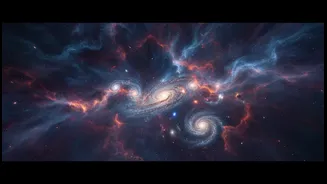
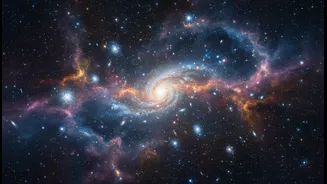
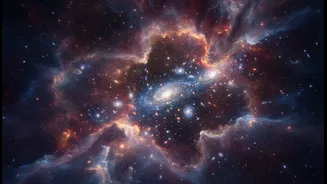
The long-held standard model of cosmology painted a picture of a young universe governed by turmoil. After the Big Bang, tiny fluctuations in density allowed gravity to slowly pull matter together. Over hundreds of millions of years, this process was
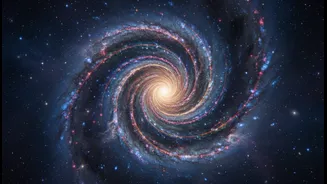
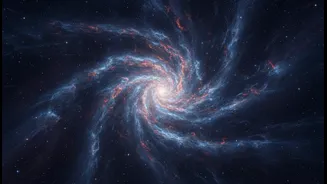
thought to be clumpy and disordered, with vast clouds of gas and dark matter gradually coalescing into the first star clusters and, eventually, chaotic and rapidly evolving galaxies. Astronomers believed that the grand, structured galaxies we see today, like our own spiral Milky Way, took billions of years to settle into their elegant forms after a long period of violent mergers and collisions. This 'bottom-up' theory suggested that order emerged from chaos only much later in cosmic history.
A Surprising Discovery of Early Order
Recent findings, however, are challenging this narrative. In a landmark study, astronomers from the Inter-University Centre for Astronomy and Astrophysics (IUCAA) in Pune used data from the James Webb Space Telescope (JWST) to peer back to when the universe was less than a billion years old. They discovered that even at this incredibly early stage, some galaxies were already remarkably well-organised. Specifically, these 'spheroidal' or rounded galaxies followed a rule known as the 'Kormendy relation', which links a galaxy's size to the brightness of its centre. This was a shock, as this relationship was previously thought to only apply to mature, older galaxies. It suggests the physical processes that shape galaxies today were already at work in the universe's infancy.
Webb: A New Window to the Dawn of Time
This breakthrough was made possible by the unprecedented power of the James Webb Space Telescope. Launched in late 2021, its massive mirror and extreme sensitivity to infrared light allow it to capture light that has been travelling for over 13 billion years, effectively acting as a time machine. Before JWST, the first billion years of cosmic history were largely inaccessible, as earlier telescopes lacked the power to resolve such distant, faint objects in detail. JWST can see the very first stars and galaxies forming in an era known as 'Cosmic Dawn'. Another study, led by Durham University, used Webb to find a complex, rotating disc of stars, known as a nuclear disc, in a galaxy seen as it was just 4.5 billion years after the Big Bang—far earlier than such organised structures were thought to exist.
Rewriting the Cosmic Playbook
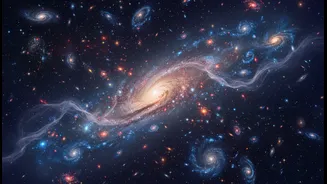
These discoveries force scientists to rethink fundamental theories of galaxy formation. The presence of organised structures so early on implies that galaxies may have formed and matured much faster than previously believed. According to IUCAA researchers, theoretical models must now explain not only how massive galaxies formed so quickly, but also why they were already obeying structural laws seen in the universe nearly 13 billion years later. This doesn't necessarily break the standard model of cosmology, but it does require significant revisions. It suggests the underlying scaffold of the universe, the vast and unseen 'cosmic web' of dark matter, might have been more influential in shaping galaxies from the very beginning than we knew. These early, orderly galaxies provide a powerful new benchmark for our understanding of how everything we see came to be.