


The New Space Race for the Internet
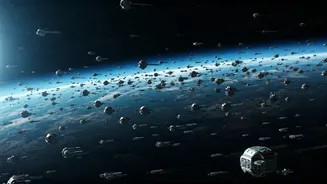
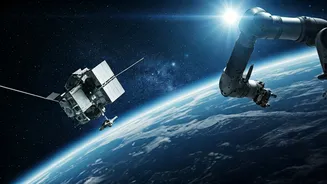
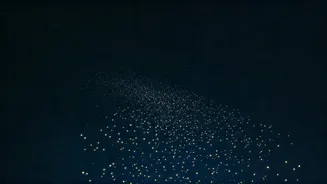
Imagine a web of thousands of satellites blanketing the Earth. This isn't science fiction; it's the era of the 'megaconstellation'. Companies like SpaceX with its Starlink network, Amazon with Project Kuiper, and others like OneWeb and China's Guowang
are in a race to provide broadband internet to every corner of the globe. To achieve this, they are deploying vast fleets of satellites into low Earth orbit (LEO), typically less than 1,200 kilometres up. The logic is simple: lower orbits mean less signal delay, which is crucial for high-speed internet. As of 2025, more than half of all active satellites were already part of a megaconstellation, a number that has skyrocketed since the first launches in 2019. If all planned projects are completed, we could see hundreds of thousands, or even over a million, new objects orbiting our planet.
A Troubled View for Astronomers
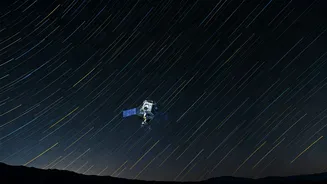
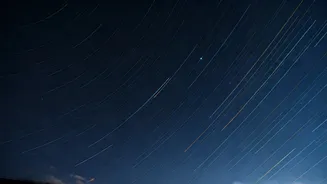
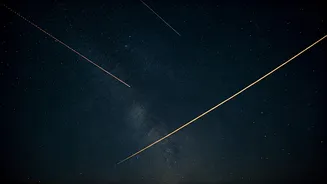
While the goal of universal internet access is laudable, it comes with a significant and unintended consequence: light pollution in space. For hours after sunset and before sunrise, these satellites in LEO are still illuminated by the sun, reflecting its light back to Earth. To the naked eye, they appear as a steady stream of moving lights, sometimes mistaken for UFOs. For astronomers, the problem is far more severe. The bright streaks left by satellites passing through a telescope's field of view can ruin long-exposure images, effectively photobombing delicate observations of distant galaxies and stars. Major observatories, like the Vera C. Rubin Observatory in Chile, are particularly vulnerable; estimates suggest that up to 30% of its images taken during twilight hours could be affected. Recent studies have warned that some future space telescopes could see nearly all of their images contaminated by satellite trails, potentially killing ground-based astronomy as we know it.
More Than Just Visual Clutter
The term 'messy' doesn't just apply to the visual impact. With tens of thousands—and potentially over a million—new satellites, the risk of collisions in an already crowded orbit grows substantially. This increases the threat of what's known as the Kessler syndrome: a runaway chain reaction of collisions where each crash creates more debris, which in turn leads to more crashes. This cloud of space junk could make low Earth orbit hazardous for decades, threatening not just future satellites but also crewed space missions. Even with built-in collision avoidance systems, the sheer volume of objects presents an unprecedented traffic management challenge in space, which currently lacks a unified system like air traffic control. Furthermore, the short 5- to 7-year lifespan of these LEO satellites means they need constant replacement, adding to the orbital population and debris risk.
Searching for a Dimmer Future
The astronomy community has been vocal about these threats, and thankfully, some operators are listening. SpaceX, for instance, has been working with astronomers to mitigate the brightness of its Starlink satellites. The company has experimented with different solutions, including special anti-reflective coatings, a dielectric mirror film that reflects sunlight away from Earth, and even using darker paints on satellite components. Newer generations of Starlink satellites are reportedly dimmer than the initial versions, despite being larger. The International Astronomical Union (IAU) has also been active, publishing recommendations for satellite operators. These include limiting operational altitudes to below 600 km where possible to reduce visibility, darkening satellite surfaces, and sharing precise location data to help observatories schedule their observations to avoid the brightest passes. However, these are largely voluntary measures, and with proposals for extremely bright constellations designed to reflect sunlight, many astronomers feel the threat is far from over.