





A Star Factory in Overdrive
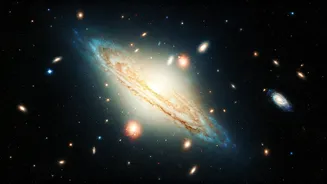
Imagine a factory working so fast it's 10 times more productive than its competitors. In cosmic terms, that's the Cigar Galaxy, or M82. It's what astronomers call a 'starburst' galaxy, a place where star formation is happening at an exceptionally high
rate. This intense activity is believed to be the result of a close encounter with its larger neighbor, the spiral galaxy M81, about 100 million years ago. The gravitational tug-of-war between the two galaxies effectively funneled huge amounts of gas into M82's core, providing the raw material for this massive stellar baby boom. At just 12 million light-years from Earth, M82 is our closest example of this violent and spectacular phase of galactic evolution, making it a prime target for astronomers trying to understand how galaxies grow.
Webb's Infrared Super-Vision
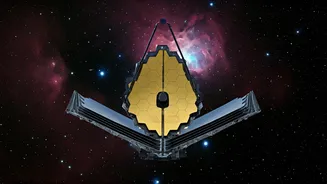
For decades, astronomers have been trying to get a clear view of the processes unfolding within M82. However, like a bustling city shrouded in smog, the galaxy’s core is obscured by thick clouds of cosmic dust, hiding the stellar nurseries from view for telescopes that see in visible light, like Hubble. This is where the James Webb Space Telescope (JWST) changes the game. Webb is designed to see the universe in infrared light, which can pass through these dense dust clouds unimpeded. Using its Near-Infrared Camera (NIRCam), a team of astronomers recently spent 65 hours staring at M82. The result is the sharpest and most detailed look inside this starburst region ever achieved, resolving approximately 16.5 million individual stars that were previously invisible.
Unpacking the Galactic Superwind
One of the most dramatic features of M82 is its 'galactic superwind'. The combined energy from thousands of young, massive stars and their subsequent supernova explosions creates a powerful outflow of gas and dust, blasting material out of the galaxy's center at immense speeds. Webb’s new images reveal this process in stunning detail. The images show fiery-looking plumes of reddish-orange material extending more than 10,000 light-years above and below the galactic disk. This material is comprised of small dust grains known as polycyclic aromatic hydrocarbons, or PAHs. These complex molecules, similar in size to particles in smoke on Earth, are crucial for tracing the flow of matter in the space between stars. By mapping these plumes, astronomers can better understand how galaxies enrich the space around them with heavy elements forged inside stars.
A Window to the Early Universe
Studying M82 isn't just about understanding one chaotic galaxy; it's like looking through a window into the distant past. Starburst galaxies like M82 are considered analogues for how galaxies behaved in the early universe, when galaxy mergers and rapid-fire star formation were much more common. The detailed fossil record of star formation preserved in M82's stars allows astronomers to piece together its evolutionary history. By seeing which stars are where, and how the galactic wind is structured, scientists can test their models of galaxy formation and evolution. According to one astronomer, M82 is an ideal laboratory for studying these fundamental processes. The data from Webb's observations will help answer long-standing questions about how this intense starburst phase begins, how long it lasts, and how it ultimately shapes the destiny of a galaxy.