





A New Cosmic Clue
In the vast, silent theatre of space, astronomers are constantly searching for clues that might point to life beyond Earth. Recently, they announced a significant finding: the detection of methane gas in the atmosphere of a distant exoplanet. This isn't
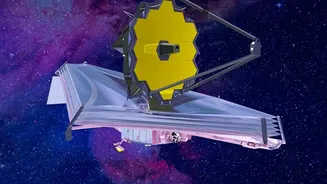
just any planet; it's a category of world known as a 'Warm Neptune.' The discovery, made possible by the unparalleled power of the James Webb Space Telescope (JWST), offers a crucial piece of the puzzle, not because it confirms life, but because it sharpens the tools we use to look for it.
What Are Warm Neptunes?
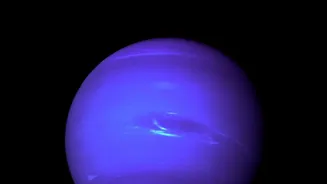
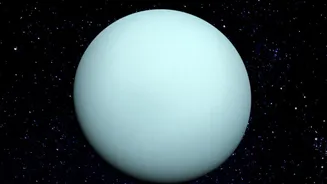
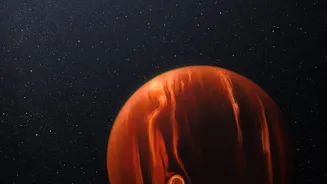
Imagine a planet similar in size to our own Neptune but orbiting much closer to its star. These are 'Warm Neptunes'. They are gas giants, but unlike the frigid worlds at the edge of our solar system, their proximity to their sun gives them warmer temperatures. However, they aren't scorched like 'Hot Jupiters' that orbit even closer. These planets, such as TOI-199b and K2-18 b, are common in our galaxy but have no equivalent in our solar system, making them objects of intense scientific curiosity. They are too large and gaseous to host life as we know it on a solid surface, which makes the discovery of methane in their atmospheres particularly intriguing for what it teaches us about planetary chemistry.
The Double-Edged Sword of Methane
On Earth, methane is strongly associated with life. It's produced by everything from microbes in wetlands to the digestive systems of livestock. Because of this, it’s considered a key 'biosignature'—a chemical fingerprint that could indicate biological processes on another world. However, methane can also be produced by purely geological phenomena, such as volcanic activity or reactions in a planet's mantle. This makes methane a double-edged sword in the search for aliens. Finding it is exciting, but it’s not definitive proof of life. Scientists must carefully analyze the planetary context to rule out non-biological sources.
A Signpost, Not a Destination
Finding methane on a Warm Neptune is not about finding life on that specific planet. Instead, it’s about calibration. By studying the atmosphere of a planet that is not considered habitable, scientists can learn how methane behaves in a non-biological environment. This helps them build more accurate models for what to look for when they turn their telescopes toward more promising candidates, like smaller, rocky, Earth-like planets. This discovery helps astronomers better distinguish a true biosignature from a geological false positive, making the entire search for extraterrestrial life more efficient and reliable. It’s like learning how a car engine sounds when it’s healthy, so you can more easily recognize the sound of a problem.
A Global Effort for a Universal Question
The James Webb Space Telescope is a testament to international collaboration, and its discoveries belong to all of humanity. While this specific finding may not have direct ties to Indian research, the broader project has significant Indian connections. Several Indian-origin scientists, including Dr. Hashima Hasan and Kalyani Sukhatme, have played key roles in the JWST's success. Furthermore, Indian astronomers from institutes like the Tata Institute of Fundamental Research (TIFR) are among the global researchers selected to use the telescope's valuable time for their own projects, exploring the birth of stars and other cosmic mysteries. This global cooperation fuels our collective quest for knowledge and inspires future generations of scientists in India and across the world.