



The New Space Race Is Smaller
Forget the monolithic, nation-state projects of the Cold War. Today's space race is faster, cheaper, and smaller. The revolution is being led by 'small satellites' or 'smallsats', a category of spacecraft that is democratising access to Earth's orbit.
Traditionally, launching anything into space was a high-stakes game, reserved for government agencies with astronomical budgets. A single large satellite could cost hundreds of millions of dollars and represent a nation's entire investment, making failure a catastrophic risk. Now, thanks to advancements in miniaturisation and standardised components, the barrier to entry has dramatically lowered, allowing universities, private companies, and emerging nations to become space-faring players.
What Exactly Is a Small Satellite?
The term 'small satellite' covers a wide range of spacecraft generally weighing under 500 kilograms. They are categorised by mass, from minisatellites (100-500 kg) down to microsatellites (10-100 kg) and nanosatellites (1-10 kg). Perhaps the most famous type is the CubeSat, a modular nanosatellite built in 10x10x10 cm units. These aren't just scaled-down versions of their larger cousins; they are designed differently. By focusing on a specific, singular purpose, they avoid the complexity of multi-mission behemoths. This streamlined approach, combined with the use of commercially available electronics, allows them to be developed in 12-24 months, a fraction of the time needed for a traditional satellite.
The Cost-Cutting Revolution
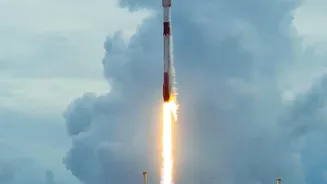
The single biggest factor making space more accessible is the drastic reduction in cost, and smallsats are at the heart of this. There are two main reasons for this. First, manufacturing is cheaper. Using standardised parts and mass-production techniques reduces design and assembly costs. Second, and more significantly, launch costs have plummeted. Because of their low mass and small size, these satellites don't always need a dedicated rocket. They can 'piggyback' on larger launches, using excess capacity that would otherwise go to waste. This rideshare model has fundamentally changed the economics of space. Furthermore, the development of launch vehicles specifically designed for small payloads, like ISRO's Small Satellite Launch Vehicle (SSLV), provides dedicated, on-demand launch capabilities at a lower price point.
India's Growing Role in the Smallsat Boom
India has enthusiastically embraced the smallsat revolution, fostering a vibrant ecosystem of private startups and government support. With the opening of the space sector to private participation, nearly 400 space startups have emerged. Companies like Skyroot Aerospace, Agnikul Cosmos, and Dhruva Space are making headlines. Skyroot, founded by former ISRO engineers, recently launched its Vikram-1 rocket, designed specifically to place small satellites into low-Earth orbit. Agnikul is pioneering 3D-printed rockets for the same market. This private-sector energy is supported by government bodies like the Indian Space Research Organisation (ISRO) and the Indian National Space Promotion and Authorisation Centre (IN-SPACe), which provide infrastructure, guidance, and act as enablers for this commercial growth.
Real-World Impact on Indian Soil
The benefits of this accessibility aren't just happening in orbit; they are creating tangible solutions on the ground. Small satellite constellations provide data for a huge range of applications. In agriculture, they offer decision intelligence to farmers. For financial services and infrastructure, they deliver insights that were previously unimaginable. Earth observation satellites help monitor deforestation, track floods and wildfires in real-time, and manage urban development. Communication constellations are working to bridge the digital divide, bringing internet access to remote and rural areas that lack terrestrial infrastructure. Startups like GalaxEye are building satellites with multi-sensor imaging to provide all-weather information for any area of interest.
The Road Ahead and Its Challenges
The future of the small satellite market looks bright, with projections showing continued strong growth. However, the path is not without obstacles. The very success of smallsats has led to concerns about orbital congestion and space debris. With thousands of new objects in low-Earth orbit, effective space traffic management is becoming critical. There are also technical limitations, such as constraints on power, propulsion, and data communication, though engineers are continuously innovating to overcome them. Despite these challenges, the momentum is undeniable. The shift toward smaller, more agile systems is not just a trend but a fundamental reshaping of our relationship with space.