




First, Let's Define 'Day' and 'Year'
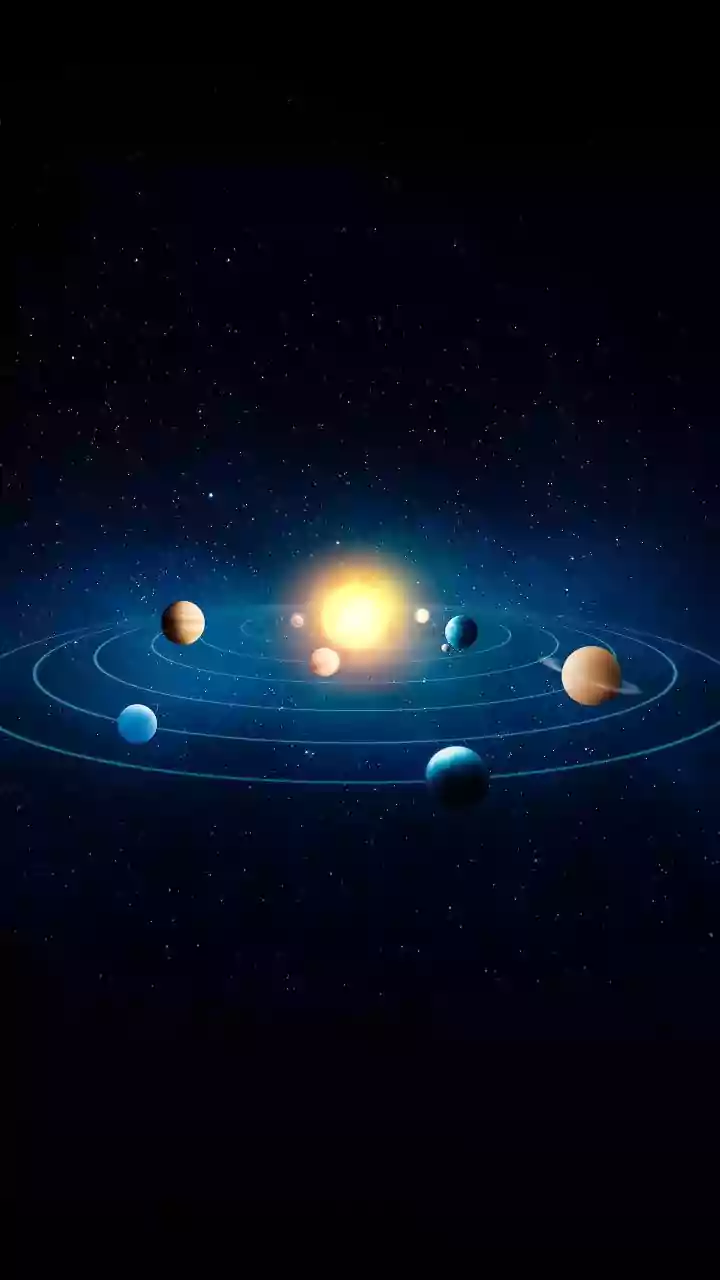
On Earth, the concepts of a 'day' and a 'year' are simple. A day is one full rotation of our planet on its axis (24 hours), and a year is one full orbit around the Sun (365.25 days). On Venus, these numbers are wildly different and, frankly, very strange.
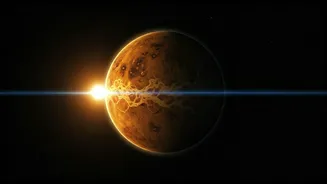
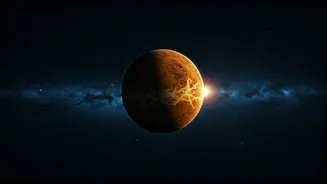
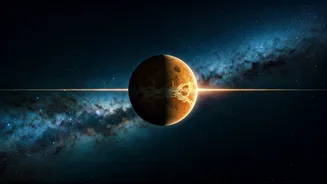
A Venusian 'year'—the time it takes to complete one orbit around the Sun—is about 225 Earth days. However, a single Venusian 'day'—the time it takes for the planet to complete one full rotation on its axis—is a staggering 243 Earth days. This means a single day of rotation on Venus is 18 Earth days longer than its entire year. It’s the only planet in our solar system with this peculiar characteristic. This simple fact sets the stage for a cosmic mystery billions of years in the making.
The Core Reason: A Backward Spin
The single biggest reason for Venus’s strange timekeeping is its retrograde rotation. While most planets in our solar system, including Earth, spin on their axis in a counter-clockwise direction (prograde), Venus spins clockwise. It is effectively rotating 'backwards.' This has a profound effect on its solar day (the time from one sunrise to the next). Because the planet is rotating so slowly in the opposite direction of its orbit around the Sun, the Sun appears to move very slowly across the Venusian sky. The combination of this slow backward spin and its orbit results in a solar day that is actually 'shorter' than its rotational day, clocking in at around 117 Earth days. So, while one full 360-degree spin takes 243 days, you’d experience roughly two sunrises and sunsets in a single Venusian year. But why does it spin backward in the first place? Scientists aren't 100% sure, but the leading theory involves a massive celestial collision deep in the solar system's past that literally knocked the planet upside down or reversed its spin.
A Thick, Heavy Blanket of Air
Venus is often called Earth’s 'twin' due to its similar size and mass, but its atmosphere is a monster. It is incredibly thick—more than 90 times denser than Earth's—and composed almost entirely of carbon dioxide. This creates a runaway greenhouse effect, making its surface hot enough to melt lead. But this thick atmosphere also plays a crucial role in slowing the planet down. It 'super-rotates,' meaning the clouds and upper atmosphere whip around the planet once every four Earth days, much faster than the planet itself spins. This creates immense friction between the atmosphere and the solid surface. Over billions of years, this atmospheric drag has acted like a powerful brake, gradually slowing Venus's rotation to its current sluggish pace. It’s like trying to spin a ball underwater versus in the air; the resistance is immense.
The Sun's Unrelenting Gravitational Pull
Another major factor is the immense gravitational influence of the Sun. Just as the Moon’s gravity creates tides in Earth’s oceans, the Sun’s powerful gravity pulls on Venus. This pull creates 'tidal bulges' not just in a hypothetical ocean, but in the planet's thick atmosphere and even in its solid crust. These tidal forces exert a torque, or a twisting force, on the planet. For a planet with a thick atmosphere like Venus, this solar tidal torque is especially powerful. Over cosmic timescales, this constant gravitational tug-of-war between the Sun and Venus’s heavy atmosphere has worked in tandem with atmospheric friction to brake its rotation, contributing to the slow, 243-day spin we observe today. Some models even suggest that without its atmosphere, Venus might have eventually become tidally locked to the Sun, with one side permanently facing it.