




The Problem with 'Wet' Batteries
Almost every electric scooter on Indian roads today runs on a lithium-ion battery. These batteries use a liquid or gel-like substance called an electrolyte to move energy-carrying ions between the positive and negative terminals. This 'wet' chemistry
works well, but it has inherent limitations. The liquid electrolyte is flammable, which creates a risk of thermal runaway—a chain reaction that can lead to fires if the battery is damaged or overheats. This is why you hear about isolated but serious scooter fires. Furthermore, this liquid-based system limits how much energy can be packed into a given space and how quickly it can be charged without causing long-term damage to the battery's health.
Enter the Solid-State Solution
Solid-state batteries are exactly what they sound like: they replace the flammable liquid electrolyte with a solid material, often a thin ceramic or polymer layer. This single architectural change brings a cascade of benefits. By eliminating the flammable liquid, the risk of fire is drastically reduced. The solid electrolyte acts as a super-stable separator that allows ions to pass through but is far more resistant to the problems that plague liquid cells, such as the formation of dendrites which can cause short circuits. This fundamental stability is the key to unlocking the next level of performance.
Safer Rides, Greater Peace of Mind
For the average scooter owner, safety is paramount. The shift to a solid electrolyte makes the battery pack far more stable across a wide range of temperatures. Whether you're riding in the scorching summer heat or cooler winter weather, a solid-state battery maintains its performance and safety profile more consistently. This inherent stability also simplifies the complex battery management systems required in current EVs, which constantly monitor for temperature spikes and cell imbalances. By designing out the primary fire risk at a chemical level, manufacturers can offer riders greater peace of mind.
Charging in Minutes, Not Hours
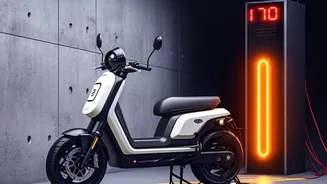
Perhaps the most significant change for daily users will be the dramatic reduction in charging time. Current lithium-ion batteries can be damaged by very high-speed charging. Solid-state batteries, however, are built to handle much higher charge rates without degrading. While today's scooters can take several hours for a full charge, developers of solid-state technology are demonstrating charge times of just 5 to 20 minutes. Imagine stopping for a cup of tea and gaining a full charge, rather than planning your entire day around an overnight plug-in. This shift transforms the scooter from a limited-range commuter vehicle into a go-anywhere, anytime mode of transport, effectively eliminating range anxiety.
More Kilometres, Less Weight
This new architecture allows for a much higher energy density, meaning more energy can be stored in the same amount of space. A solid-state battery pack of the same physical size as a current lithium-ion one could potentially double the scooter's range. A scooter that gets 80 km on a charge could suddenly offer 160 km or more. Alternatively, manufacturers could keep the same range but make the battery pack significantly smaller and lighter, improving the scooter's handling and efficiency. This ability to pack more power into a smaller, safer package is why companies are investing heavily in this technology for two-wheelers.
When Will This Tech Hit Indian Roads?
The transition won't happen overnight. Solid-state batteries are currently expensive to produce, and scaling up manufacturing is a major hurdle. However, the race is on. Several companies showcased production-ready or near-production solid-state batteries for two-wheelers at tech events in 2026. In India, major players like Ola Electric have confirmed they are actively developing solid-state battery technology. Initially, this technology will likely appear in premium scooter models. As manufacturing becomes more efficient and costs come down over the next few years, solid-state batteries are expected to become the new standard, trickling down into more affordable mass-market models.