








The Allure of a 'Hycean' World
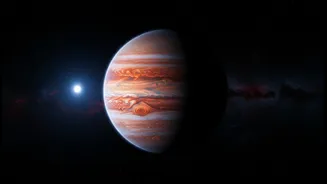
Located 124 light-years away, K2-18b is a 'sub-Neptune' exoplanet, about 8.6 times the mass of Earth. It orbits within its star's habitable zone, the region where temperatures could allow for liquid water. This has led to the exciting hypothesis that
K2-18b could be a 'Hycean' world—a theoretical type of planet with a deep, global ocean of liquid water underneath a hydrogen-rich atmosphere. Observations from the James Webb Space Telescope (JWST) have detected methane and carbon dioxide in its atmosphere, which is consistent with this picture and has made it one of the most compelling targets in the search for extraterrestrial life.
A Tantalising, but Troublesome, Signal
The real excitement began with the potential detection of dimethyl sulfide (DMS) in K2-18b's atmosphere. On Earth, DMS is almost exclusively produced by life, particularly marine microorganisms like phytoplankton, making it a powerful potential 'biosignature'—a chemical fingerprint of biological processes. However, the signal has been weak and is a subject of intense scientific debate. Several independent analyses of the JWST data have concluded there is insufficient evidence to confirm the presence of DMS. The initial report had a confidence level that, while high, was not enough to claim a definitive discovery, leaving open the possibility of a statistical fluke or an alternative explanation.
The Challenge of False Positives
This is where the concept of a 'false positive' becomes critical. A false positive is an event or signal that mimics the signature you're looking for. In astrobiology, it means a chemical or signal that looks like a sign of life but is actually produced by non-biological (abiotic) processes. Recent research has shown that processes involving atmospheric chemistry, particularly reactions triggered by starlight, could potentially produce DMS without any life being present. Other false positives can occur when the light from a background eclipsing binary star blends with the target star's light, creating a dip in brightness that looks like a transiting planet. Even an exoplanet's moon could contaminate the spectrum, creating a misleading chemical signature. For K2-18b, the core challenge is distinguishing a true biological signal from these planetary and instrumental impostors.
New Methods Sharpen the Search
To tackle this, scientists are developing increasingly sophisticated methods to filter out the noise. This involves more than just re-analysing the data; it's about creating better models and using multiple, independent teams and techniques. For K2-18b, a NASA-led analysis combined several new observations and models to re-evaluate the DMS claim. They found that while the planet is water-rich, the DMS signal was not statistically significant and could be explained by non-living atmospheric chemistry. Similarly, in the search for technosignatures (signs of technology), a recent radio survey of K2-18b used advanced software to sift through millions of potential signals, filtering out Earth-based interference to look for genuine artificial transmissions. Though none were found, the project proved the effectiveness of the new filtering approach for future searches.
Why This Efficiency is Crucial
This process of identifying and eliminating false positives saves an incredibly precious resource: telescope time. The James Webb Space Telescope, our most powerful eye on the universe, has a limited lifespan and there is immense competition for its use. Its time is meticulously scheduled for everything from studying the first galaxies to examining the birth of stars. By developing robust methods to weed out unpromising candidates on the ground, astronomers can avoid wasting valuable JWST observation hours chasing ghosts. This allows researchers to focus the telescope's power on the most promising targets, dramatically accelerating the pace of discovery. It makes the entire scientific endeavour smarter, more efficient, and ultimately, more likely to succeed.