

Seeing the Invisible Light
To understand why infrared photography is such a game-changer, we first need to talk about light. The rainbow of colours our eyes can see is just a tiny fraction of the light that exists. Beyond the red end of the spectrum lies infrared light, which our eyes can't
detect but we can feel as heat. For astronomy, this invisible light is a key that unlocks two major cosmic secrets. First, infrared light has longer wavelengths that can pass through thick clouds of cosmic gas and dust that would otherwise block our view. This allows telescopes like the James Webb Space Telescope (JWST) to peer into stellar nurseries and the hearts of dusty galaxies. Second, and most importantly for studying the early universe, infrared is the key to looking back in time.
A Time Machine Called Redshift
The universe has been expanding since the Big Bang. As it expands, it stretches everything within it, including the light traveling through space. This phenomenon is called 'cosmological redshift'. Imagine the light from a very distant, ancient galaxy starting its journey towards us. As it travels across billions of years through an expanding universe, its light waves get stretched out. Light that might have been emitted as visible or even ultraviolet light gets stretched so much that by the time it reaches our telescopes, it has shifted into the infrared part of the spectrum. The farther away a galaxy is, the more its light is redshifted. This is why JWST, an observatory optimized to detect infrared light, is essentially a time machine, capable of seeing galaxies that formed just a few hundred million years after the Big Bang.
Hubble vs. Webb: A New Cosmic Dawn
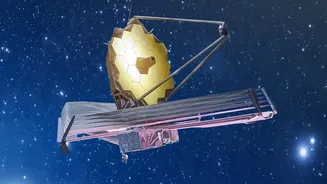
Before JWST, the Hubble Space Telescope gave us our deepest views of the cosmos, like the iconic Hubble Ultra Deep Field, which revealed thousands of galaxies. Hubble can see a sliver of infrared light, but its primary vision is in the visible and ultraviolet spectrum. While it could spot galaxies from when the universe was about 800 million years old, the very earliest, most redshifted galaxies remained hidden. When JWST revisited Hubble's deep field, the difference was astounding. With its massive, gold-coated mirror designed for infrared sensitivity, Webb revealed countless previously invisible, ancient red galaxies in a fraction of the observation time. It is revealing what astronomers call the 'Cosmic Dawn'—the era when the very first stars and galaxies began to shine, a period previously confined to theory.
Galaxies Too Big, Too Soon
What JWST is finding in this ancient past is shaking up astronomy. According to previous models, the first galaxies should have been small, clumpy, and chaotic. Instead, Webb is discovering galaxies that are surprisingly massive, mature, and well-structured far earlier than believed possible. Some recent discoveries have identified huge galaxies and galaxy proto-clusters appearing just 500-700 million years after the Big Bang, a time when there shouldn't have been enough material or time for such giants to form. Recent findings even suggest these early massive galaxies might contain up to four times more stars than previously estimated, deepening the puzzle. Astronomers are also finding 'dead' galaxies that have already stopped forming stars in vast, early cosmic structures, a sign of unexpectedly rapid evolution.
Rewriting the First Chapter of the Universe
These discoveries don't break our understanding of the Big Bang, but they do force a major rethink of how quickly the universe 'grew up'. The presence of massive, mature galaxies and surprisingly large early black holes suggests that the processes of galaxy and star formation were far more efficient and rapid than our models predicted. It’s like finding a fully grown adult in a nursery. Scientists are now scrambling to adjust theories to account for this accelerated evolution. Each new image from Webb's infrared cameras adds another piece to this perplexing and exciting new puzzle, fundamentally changing the first chapter of our universe's history. We are seeing not only that the lights turned on earlier than we thought, but that entire cities were built in what was supposed to be the cosmic dark ages.