


Gravity Sets the Stage, But Isn't the Whole Show
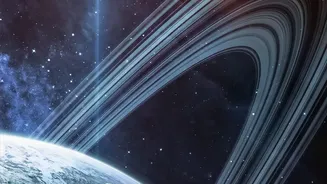
First, let's give gravity its due. This fundamental force is the primary reason planetary rings exist. It captures countless particles, from house-sized boulders to tiny grains of dust, and corrals them into a flat, orbiting disc. For the larger, heavier
pieces of rock and ice, gravity is pretty much the only force that matters. They follow predictable Keplerian orbits around their host planet, like miniature moons. But for the smallest, finest particles—dust that is often no larger than the particles in smoke—the story gets much more complicated. Gravity holds them in the rings, but another force dictates their strange and sometimes surprising behavior.
Getting an Electric Charge
For magnetism to have any effect, an object must have an electric charge. Planetary ring dust is no different. These tiny grains become charged primarily through two processes. The first is the photoelectric effect: when ultraviolet (UV) light from the Sun strikes a dust grain, it can knock electrons loose, leaving the grain with a net positive charge. The second involves the planet's magnetosphere, which is a bubble of magnetism surrounding the planet filled with a sea of charged particles called plasma. As dust grains move through this plasma, they are constantly bombarded by electrons and ions, which also gives them an electric charge.
Enter the Planet's Magnetic Field
Most giant planets, like Jupiter and Saturn, have powerful magnetic fields generated by the movement of materials deep within their interiors. This magnetic field rotates along with the planet, sweeping through space like a colossal, invisible lighthouse beam. Once a dust particle has an electric charge, it can no longer ignore this rotating magnetic field. It becomes subject to the Lorentz force, an electromagnetic push or pull that affects any charged particle moving through a magnetic field. This means the fine dust in the rings is engaged in a constant dance between the steady pull of gravity and the dynamic influence of electromagnetism.
The Mysterious 'Spokes' of Saturn
The most dramatic visual evidence of this interaction are the 'spokes' in Saturn's rings. First observed by the Voyager spacecraft in the 1980s, these are vast, transient, radial features that stretch across the rings, sometimes for thousands of kilometers. They defy gravity by not orbiting with the rest of the ring material, instead rotating along with the planet's magnetic field. The leading theory is that these spokes are essentially clouds of fine, electrically charged dust particles that have been levitated out of the main ring plane by electromagnetic forces. Their appearance seems to be seasonal, becoming more frequent and prominent around Saturn's equinoxes, when the Sun's solar wind is thought to interact more intensely with the planet's magnetosphere.
A Cosmic Tug-of-War
The effect of this magnetic interaction isn't just about creating visual spectacles like the spokes. It actively sorts and moves fine dust throughout the ring system. Depending on the particle's size, charge, and location, the magnetic field can push it into different orbits, cause it to clump together, or even eject it from the rings entirely. For some micron-sized particles, the electromagnetic force and the force from planetary oblateness can nearly cancel each other out, allowing the much weaker pressure from sunlight to dictate their movement. This cosmic tug-of-war between gravity and electromagnetism helps explain the complex structures, gaps, and tenuous outer rings that we observe, which cannot be explained by gravity alone.
Why We Study This Dusty Dance
Understanding these fine-particle dynamics is more than just solving a cosmic puzzle. Planetary rings are natural laboratories for processes that occurred in the early solar system, when planets were first forming from dusty disks. By studying how dust behaves in these environments, scientists can gain crucial insights into planet formation. Furthermore, this knowledge is vital for space exploration. Charged dust can pose a hazard to spacecraft, and understanding its behavior is essential for designing missions that can safely navigate through or near ring systems. It reveals the hidden physics that shape not just the beautiful rings we see, but the very evolution of planetary systems.