



Cosmic Lighthouses in the Dark
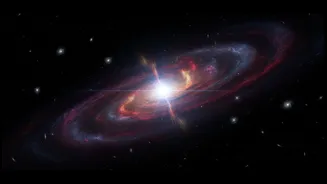
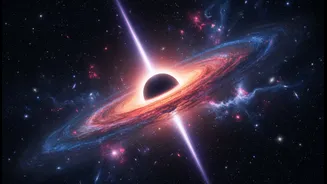
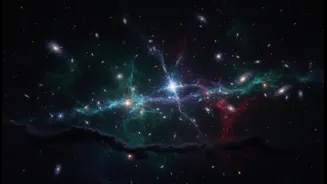
The flashlights in this story are quasars, and they are almost incomprehensibly bright. A single quasar can outshine an entire galaxy of billions of stars. They are not stars, but rather the intensely luminous cores of very young galaxies, each powered
by a supermassive black hole actively feeding on surrounding gas and dust. As this material swirls into the black hole, it heats up and radiates an enormous amount of energy across the electromagnetic spectrum. Because they are so bright, quasars can be seen from billions of light-years away, making them invaluable beacons from the early universe. Their light travels for aeons to reach our telescopes, carrying with it secrets of the long-ago cosmos.
Reading Light's Fingerprints
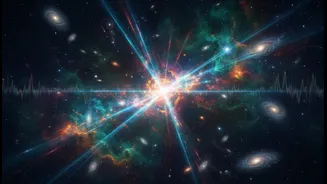
The key to unlocking these secrets lies in a technique called spectroscopy. When light from a source like a quasar passes through a cloud of gas, atoms within that gas absorb specific wavelengths (or colours) of light. Each chemical element has a unique 'fingerprint' of wavelengths it absorbs. When astronomers analyse the spectrum of a distant quasar, they see a series of dark lines, called absorption lines. These lines are a barcode that reveals the chemical composition, temperature, and density of the gas the light travelled through on its journey to Earth. This allows scientists to study the vast, mostly empty space between galaxies, known as the intergalactic medium (IGM), which contains the majority of the universe's ordinary matter.
The Universe's Foggy Era
The 'transformative cosmic epoch' mentioned in the headline is a crucial period known as the Epoch of Reionization. For hundreds of millions of years after the Big Bang, the universe was filled with a dense, neutral hydrogen gas that made it opaque, an era often called the Cosmic Dark Ages. Then, as the first stars and galaxies began to form, their intense ultraviolet radiation started to ionize this neutral hydrogen, stripping electrons from the protons. This process created expanding bubbles of transparent, ionized gas. Over time, these bubbles grew and merged until the entire universe became the transparent cosmos we know today. The Epoch of Reionization, which ended about one billion years after the Big Bang, marks this fundamental change in the state of the universe.
How Quasars Map the Past
By combining these ideas, astronomers perform a kind of cosmic archaeology. When they observe a very distant quasar, its light has passed through the intergalactic medium as it existed during the Epoch of Reionization. The spectrum of that light is therefore imprinted with a detailed record of the state of the gas from that time. A thicket of absorption lines from neutral hydrogen, known as the 'Lyman-alpha forest', tells scientists where the cosmic fog had not yet lifted. By observing many quasars at different distances (and therefore from different points in cosmic history), they can piece together a 3D map of how reionization progressed, tracking how the bubbles of ionized gas grew and eventually overlapped to clear the entire universe. Recent discoveries from missions like the Euclid space telescope have dramatically increased the number of known ancient quasars, giving scientists a much larger sample to study this era.
What We Are Learning
This technique provides crucial insights that are difficult to obtain any other way. It helps pin down the timeline of reionization, showing it was a patchy, complex process that happened at different times in different places. The spectra can also reveal the chemical composition of this early gas, showing traces of heavy elements forged in the very first stars. These observations place important constraints on our models of how the first supermassive black holes and galaxies formed and grew. Each new ancient quasar discovered and analysed with powerful instruments like the James Webb Space Telescope provides another line of sight into this formative period, refining our understanding of how the dark, simple universe evolved into the complex, star-filled cosmos we see today.