







A Cosmic Needle in a Haystack
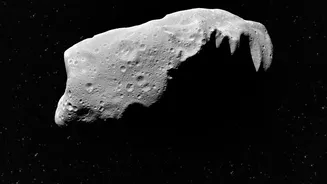
The primary challenge is one of scale. Space is incomprehensibly vast, and most asteroids are, in cosmic terms, incredibly small. While survey programs have successfully cataloged over 90% of the near-Earth asteroids (NEOs) larger than one kilometer—the
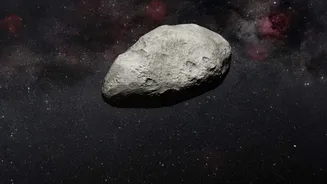
'planet-killer' size—the detection rate plummets for smaller objects. Many potentially hazardous asteroids measure just 140 meters across, large enough to cause major regional damage, but fiendishly difficult to spot. A key reason for this is their composition. Many asteroids are as dark as charcoal, reflecting very little sunlight. Trying to spot a small, dark object against the blackness of space from millions of kilometers away is an immense technological challenge. Their size is often estimated not by direct observation but by how much light they reflect, a property known as absolute magnitude. For smaller, darker rocks, this reflected light is so faint they can easily be missed by ground-based telescopes.
Hiding in the Sun’s Glare
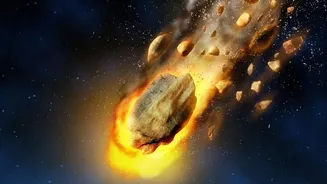
One of the most significant blind spots for our planetary defense systems is the Sun. When an asteroid approaches Earth from the same general direction as the sun, the star's overwhelming glare effectively hides it. This is precisely what happened with the Chelyabinsk meteor, which exploded over Russia without any prior warning. Our ground-based telescopes are designed for night-sky observation, looking away from the Sun. As a result, the vast majority of asteroid discoveries—some estimates say 87%—are made on the 'night side' of Earth. This leaves us vulnerable to asteroids with specific orbits, such as the 'Atira' group, which orbit entirely within Earth's path around the Sun. They rarely venture into the dark skies where our telescopes are looking, spending most of their time lost in the daytime glare. Spotting these objects is like trying to see a speck of dust in front of a powerful spotlight.
Speed, Trajectory, and Surprise
Near-Earth objects are not drifting lazily through space; they are moving at incredible velocities. An asteroid's apparent speed across the sky can make it difficult for survey telescopes to capture a clear enough image to identify it and calculate an orbit. Furthermore, their orbits are not always stable or predictable over long periods. Gravitational tugs from planets like Jupiter can alter an asteroid's path, sending it on a new trajectory that brings it closer to Earth. Some asteroids also have orbits that are highly inclined, meaning they travel far above or below the plane where most planets orbit. Our surveys tend to focus on this plane, known as the ecliptic, creating another potential blind spot. An object coming at us from a steep angle could be missed until it's very close. This combination of high speed and potentially erratic orbital behavior means that the window for detection can be alarmingly short, sometimes just a few weeks.
Building a Better Watchtower
Recognizing these limitations, space agencies are developing new tools to close the gaps in our planetary defense. The most significant upcoming project is NASA's Near-Earth Object (NEO) Surveyor space telescope, slated to launch no earlier than September 2027. Unlike ground-based optical telescopes that rely on reflected visible light, NEO Surveyor will be an infrared telescope. This is a game-changer because even dark asteroids, when heated by the Sun, glow in infrared wavelengths. This allows the telescope to detect objects based on their heat signature rather than their reflectivity. Crucially, NEO Surveyor will be positioned at a Lagrange point between the Earth and the Sun, a gravitationally stable spot that allows it to look outward and spot asteroids coming from the sun's direction. The mission's goal is to find at least two-thirds of the potentially hazardous objects larger than 140 meters, giving us a much clearer picture of any potential threats.