





Europa: A Moon of Mystery
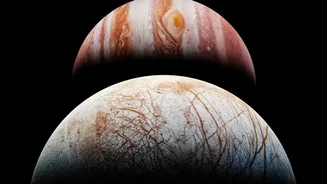
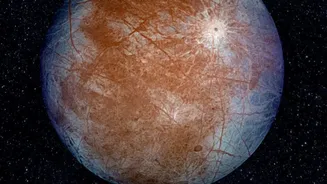
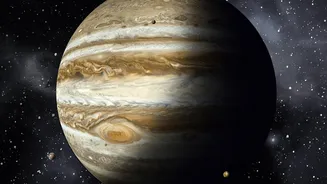
Europa has long fascinated scientists. It is slightly smaller than Earth’s Moon, but it is one of the most compelling targets in the search for life beyond our planet. Data from previous missions, like Galileo, hinted that a vast, global ocean of liquid
saltwater is churning beneath an ice crust that could be kilometres thick. The key evidence is a weak magnetic field around Europa, which seems to be induced by Jupiter's powerful magnetic field. For this to happen, Europa needs a global layer of electrically conductive fluid, and a salty ocean fits the description perfectly.
The Detective on the Case
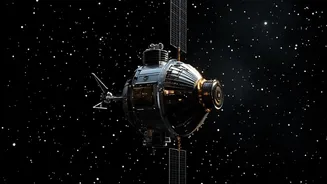
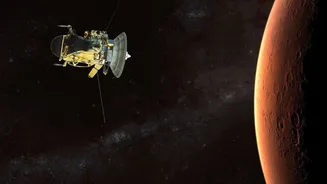
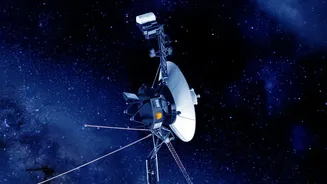
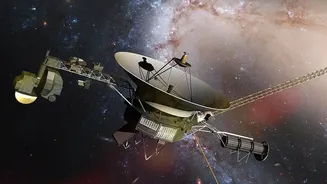
Enter NASA’s Europa Clipper. Launched in October 2024, this sophisticated probe is the largest interplanetary spacecraft the agency has ever built. It’s not designed to find life directly but to confirm if the conditions for life exist. To do this, it is equipped with nine advanced science instruments, including ice-penetrating radar, spectrometers to analyze surface composition, and magnetometers. After a long journey that includes gravity assists from Mars and Earth, Clipper is scheduled to arrive in orbit around Jupiter in April 2030 and will begin a series of nearly 50 close flybys of Europa, some as low as 25 kilometres above the surface.
Weighing an Ocean From Space
One of the most ingenious experiments on board is the Gravity/Radio Science investigation. It doesn't rely on a single, dedicated sensor but uses the spacecraft's entire telecommunications system as a giant gravity probe. The fundamental principle is simple: gravity affects the spacecraft’s trajectory. As Europa Clipper flies past the moon, any variations in the gravity field below—a dense rocky core versus a less dense liquid ocean or ice shell—will minutely pull on the spacecraft, altering its speed and path. By precisely measuring these tiny changes, scientists can create a map of Europa's interior structure.
Listening for a Doppler Wobble
The measurement is achieved by tracking the Doppler shift in radio signals sent between the spacecraft and Earth. Antennas from NASA’s Deep Space Network on Earth send a signal to Clipper, which then sends a coherent signal back. As Europa's gravity tugs on the probe, it causes a tiny change in the frequency of the return signal. Scientists can analyze this shift to measure the spacecraft’s velocity with incredible precision. It’s similar to how the pitch of a firetruck's siren changes as it moves past you. These measurements will allow the science team to map out how mass is distributed inside Europa.
The Telltale Tidal Flex
The real magic happens by repeating these measurements over many flybys. Europa is in an elliptical orbit, meaning its distance from Jupiter changes. When it’s closer, Jupiter's immense gravity pulls harder, causing the moon to slightly elongate. When it's farther away, it becomes more spherical. If a global ocean exists, Europa will flex significantly. If it’s frozen solid, it will barely budge. By measuring how much Europa's gravity field changes as it flexes, scientists can determine its “tidal Love number,” a value that reveals how squishy the interior is. This will provide definitive proof of the ocean and help estimate its depth and the thickness of the ice shell above it.
The Ultimate Goal: A Habitable World?
Confirming a liquid water ocean is the first step. The Gravity/Radio Science experiment, combined with data from the ice-penetrating radar and magnetometer, will build a comprehensive model of Europa's interior. This will help answer key questions for astrobiology: How thick is the ice? How deep and salty is the ocean? Does the ocean interact with the rocky seafloor, a process that could supply chemical nutrients necessary for life? While Europa Clipper won't be able to peer into that dark ocean, its gravitational investigation will tell us if it’s a world we need to explore more closely, perhaps one day with a lander designed to drill down and touch the water itself.