





Why August is Saturn's Month
Throughout August 2026, Saturn is moving towards a special event called 'opposition'. While the official date for opposition is October 4th, the planet's journey there makes August a fantastic viewing period. Opposition occurs when Earth passes directly
between the Sun and an outer planet, like Saturn. Think of it as a celestial lineup with Earth in the middle. This alignment means Saturn is at its closest point to us for the year, making it appear bigger and brighter in our sky. The planet will rise in the east around sunset and remain visible for most of the night, tracking across the sky until it sets in the west around sunrise. This makes for long, convenient viewing sessions.
Your Viewing Guide: When and Where
Saturn will be visible all through August, rising in the late evening and becoming easier to spot as the month progresses. For observers in India, the planet can be seen for several hours through the late night and early morning. To find it, you'll want to look towards the constellation Pisces, near its border with Cetus. While it will be one of the brightest objects in that patch of sky, shining with a steady, yellowish light, using a stargazing app on your smartphone can help you pinpoint its exact location with ease. On August 4th and again on August 31st, the Moon will be near Saturn, providing a helpful landmark for locating the planet.
What You'll Need to See the Spectacle
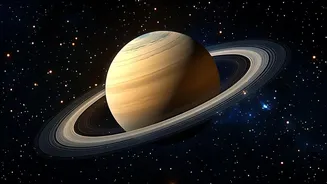
The great news is that you don't need a professional observatory to enjoy this show. Saturn is bright enough to be seen with the naked eye, where it will look like a particularly bright, non-twinkling star. To get a better look, a simple pair of binoculars will begin to reveal that Saturn is not a point of light but has a slightly elongated, oval shape. This is the first hint of its famous rings. To truly witness the magic, however, a small telescope is your best bet. Even a basic 3-inch (75mm) telescope with a magnification of 50x can clearly show the rings as a separate structure around the planet. It's a sight that has hooked countless people on astronomy for life.
What to Look For: Rings, Moons, and More
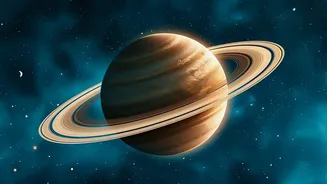
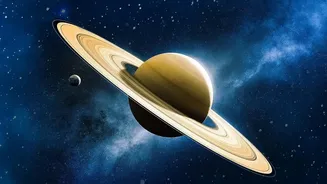
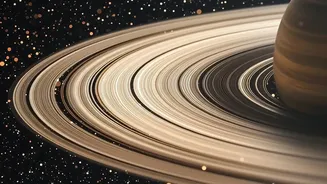
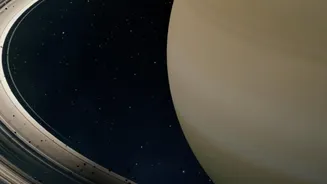
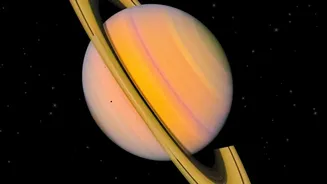
The main attraction is, of course, the rings. In August 2026, the rings are tilted towards Earth at a favourable angle, making them clearly distinguishable from the planet's disk even in small scopes. With a slightly larger backyard telescope (4 to 8 inches), you might be able to spot the Cassini Division, a dark gap that separates the main rings. But Saturn offers more than just its rings. Look closely for Saturn's largest moon, Titan, which will appear as a tiny star-like point of light near the planet. With a good telescope and steady air, you might even glimpse a few other moons like Rhea, Dione, and Tethys. Looking at the planet itself, you may notice subtle cloud bands—darker belts and lighter zones—across its surface.