








The End of Business as Usual
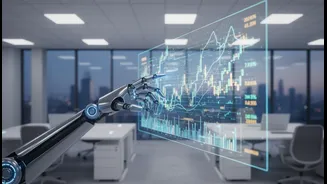
The traditional image of a junior finance professional—hunched over spreadsheets, manually crunching numbers, and preparing routine reports—is fading fast. The rise of sophisticated AI, especially generative AI and machine learning, is automating many
of the foundational tasks that once formed the bedrock of early-career roles. According to recent reports, tasks like data processing, basic financial modeling, and even summarizing annual reports are now being handled by intelligent systems. This shift is most pronounced for entry-level analysts, whose work often involves the exact kind of repetitive, data-heavy tasks that AI excels at. The result is a fundamental change in what companies expect from new hires. It’s no longer enough to be a human calculator; the real value now lies in skills that machines can't replicate.
The New 'Hybrid' Skill Set
The future of finance belongs to professionals who can master the intersection of financial acumen and technological fluency. This doesn't mean every finance graduate needs to become a full-stack developer. However, a new set of 'hybrid' skills is now non-negotiable. On the technical side, there is soaring demand for graduates with a working knowledge of data analytics, AI and big data concepts, and programming languages like Python. Understanding how to use AI tools for forecasting, data visualization, and automating analysis is becoming a core competency. But technical skills are only half the story. As AI handles routine computation, the premium on uniquely human skills has skyrocketed. These include critical thinking, strategic communication, ethical reasoning, and adaptability. The modern finance professional must be able to interpret AI-generated insights, ask critical questions, and explain complex data to clients and decision-makers in simple terms.
AI as a Co-pilot, Not a Competitor
The narrative of AI replacing finance jobs is a common but misleading one. A more accurate picture is that of AI as a co-pilot, augmenting human capabilities rather than eliminating them. Machines handle the rapid computation and pattern recognition, freeing up human professionals to focus on strategy, client relationships, and ethical judgment—areas where AI falls short. Think of it this way: AI can analyse millions of data points to identify a potential investment, but a human is needed to understand the client's risk tolerance, build trust, and make the final strategic decision. This collaborative ecosystem means that the most valuable professionals will be those who can effectively manage and query AI systems, validate their outputs, and translate those findings into actionable business strategy. The goal is to work alongside AI, leveraging its power to deliver faster, more accurate insights.
How Education is Adapting
In response to this industry-wide shift, business schools across India are rapidly overhauling their curricula. Leading institutions like the IIMs and ISB are no longer treating technology as a peripheral subject. Instead, they are integrating courses on AI, machine learning, and business analytics directly into their core finance programs. Many B-schools now offer specialized MBA tracks in business analytics or provide the flexibility for finance majors to minor in information systems. Professional bodies are also adapting. The CFA Institute, for example, has integrated practical skills modules covering Python and AI into its program, acknowledging that these skills are now essential. This educational evolution is designed to produce graduates who are not just financially literate but also tech-savvy, ready to step into the hybrid roles that the modern financial industry demands.