


The Sun's Unseen Temper
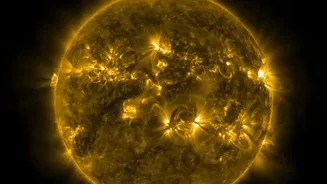
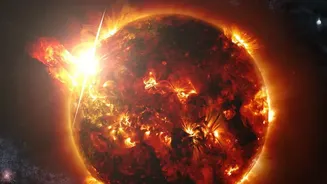
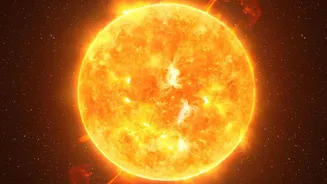
The Sun is not just a steady ball of light; it has a dynamic and often violent atmosphere. It regularly releases enormous bursts of energy and matter. The most significant of these are Coronal Mass Ejections (CMEs). A CME is a massive eruption of magnetised
plasma from the sun's outer atmosphere, the corona. Think of it as a cosmic cannonball of charged particles, sometimes weighing billions of tons, hurtling through space at speeds of up to two million miles per hour. While the sun ejects these in all directions, the ones aimed at Earth are a major concern for our technology-dependent civilisation.
Our Fragile Digital Lifeline
When a CME collides with Earth's magnetic field, it can trigger a geomagnetic storm. This storm can have devastating effects on the infrastructure that powers our daily lives. For satellites in orbit, the consequences can be severe. The influx of charged particles can damage sensitive electronics and solar panels, degrade their orbits by increasing atmospheric drag, and even cause complete system failures. This disrupts everything from GPS navigation—which can see errors from a few meters to total signal loss—to television broadcasting and, critically, the global financial and communication networks that form the backbone of modern business. On the ground, these storms can induce powerful currents in power grids, potentially leading to widespread blackouts, like the one that struck Quebec in 1989.
Creating an Artificial Eclipse
The key to protecting ourselves from CMEs is seeing them coming. The problem is that the sun's surface, the photosphere, is so blindingly bright that it completely obscures the much fainter corona where CMEs originate. This is where the coronagraph comes in. Invented in 1930 by Bernard Lyot, a coronagraph is a special telescopic instrument designed to create an artificial solar eclipse. By using a precisely placed occulting disk to block the direct light from the sun, it allows scientists to continuously observe the faint, intricate structures of the corona. While ground-based coronagraphs exist, satellite-based versions are far more effective because they operate above Earth's light-scattering atmosphere.
An Early Warning System in Space
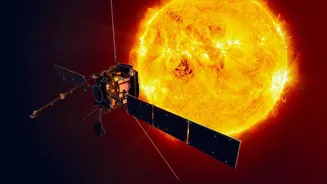
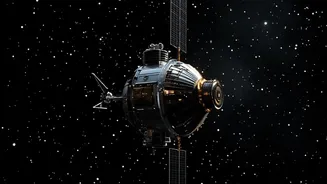
The headline's term "shield" is more of a metaphor for an advanced warning system. Coronagraphs don't physically block a solar storm, but they provide something just as valuable: time. By placing satellites equipped with coronagraphs in orbit, such as the venerable ESA/NASA SOHO spacecraft or NOAA's newer GOES-U, scientists can watch for CMEs as they erupt from the sun. These instruments capture images that allow forecasters at places like NOAA's Space Weather Prediction Center (SWPC) to detect a CME, analyze its size, speed, and direction, and determine if it's headed for Earth. This provides a crucial warning that can range from a few hours to several days, depending on the storm's speed and the satellite's location.
From Warning to Action
This lead time is what allows us to "shield" our communications. With a reliable forecast in hand, satellite operators can take protective measures. They can switch non-essential systems off or put the entire spacecraft into a protective "safe mode" to reduce the risk of electrical damage from charged particles. Power grid operators can prepare their systems to absorb the impact of induced currents, helping to prevent blackouts. Airlines can even reroute flights, particularly those over polar regions, to avoid communication blackouts and heightened radiation exposure for passengers and crew. In essence, coronagraphs act as our indispensable sentinels, giving us the foresight needed to brace for impact and mitigate the worst effects of the sun's fury.