





A Doctor, Pilot, and Now, Astronaut
Anil Menon’s journey to the stars is a story of remarkable dedication and diverse expertise. Born in Minnesota to parents from India and Ukraine, Menon is a US Space Force colonel with a background that seems tailor-made for the frontiers of space. He's
not only an emergency medicine physician with experience in extreme environments—from treating earthquake victims in Haiti and Nepal to caring for climbers on Mount Everest—but also a former flight surgeon for NASA and the first-ever flight surgeon at SpaceX. At SpaceX, he helped launch the company’s first human spaceflights and worked on the development of Starship, the vehicle designed for missions to the Moon and Mars. Selected as a NASA astronaut in 2021, his unique combination of medical, engineering, and operational experience makes him a key player in preparing for long-duration space exploration.
The ISS: A Proving Ground for the Moon
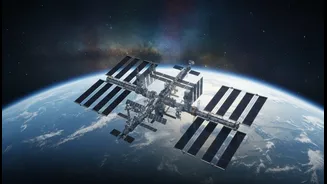
To go to the Moon for extended periods, we must first master living in space closer to home. The International Space Station, orbiting about 400 kilometres above Earth, serves as the perfect laboratory for this. It’s a unique environment where scientists can study the long-term effects of microgravity and radiation on the human body—two of the biggest challenges for lunar missions. Everything from life support systems and water recycling to new technologies for communication and navigation are tested and perfected on the ISS before they are deemed ready for the much harsher and more isolated environment of deep space. An eight-month stay, like Menon's, provides invaluable data, far beyond what shorter missions can offer, on how to keep astronauts healthy and equipment functioning on a trip to the Moon and back.
Solving the Human Body Puzzle
Menon's role as a physician-astronaut is particularly critical. Long-duration spaceflight takes a significant toll on the body. Astronauts experience muscle atrophy, bone density loss, and changes to their cardiovascular system and vision. As a flight surgeon, Menon is not just a passenger; he's a researcher and a medical officer. During his mission, he will conduct experiments to study these physiological effects, such as how microgravity impacts blood flow and composition. One key experiment involves testing technology to produce intravenous (IV) fluids from the station’s drinking water—a capability that would be a game-changer for medical emergencies on deep-space missions where carrying extensive medical supplies is impossible. This research directly informs how NASA will prepare and protect the health of Artemis astronauts on missions that will be much farther from Earth, without the possibility of a quick return.
Testing Tech for a Lunar Outpost
Beyond human health, Menon’s mission will contribute to testing the hardware essential for a sustainable lunar presence. The Artemis program isn't just about planting a flag; it's about building a long-term base on the Moon and the Lunar Gateway, a space station in lunar orbit. This requires robust and reliable technology. The ISS is where NASA validates next-generation systems for everything from carbon dioxide removal and fire suppression to advanced robotics. For example, research into 'organ-on-a-chip' technology, which uses small devices with human cells to study the effects of space on organs, is being pioneered on the ISS before being used on Artemis missions. By living and working with these systems for months, astronauts like Menon can identify flaws and help engineers refine them, ensuring they are ready for the high-stakes environment of the Moon, where repairs and resupplies are infinitely more complex.