





The Great Data Traffic Jam
For decades, the mission for most satellites was simple: collect data, and send it all back home. But as sensors have become exponentially more powerful, this model has created a cosmic traffic jam. Earth-observation satellites can generate terabytes
of high-resolution imagery daily, far more than can be efficiently sent back to Earth. This is known as the "downlink bottleneck." Imagine trying to download a movie library through a dial-up modem; the data is there, but the pipe is too small. The problem is compounded by the fact that much of this data is unusable—think images completely obscured by clouds or vast, empty stretches of ocean. Traditionally, all of this data, useful or not, had to be transmitted to a ground station before a single pixel could be analyzed, causing significant delays.
Putting the Brain on the Satellite
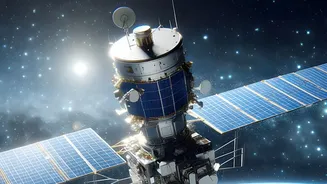
The solution is to move the analysis from the ground to the source. This is where Artificial Intelligence and edge computing come in. By equipping satellites with powerful, compact processors, they can be transformed from simple data collectors into intelligent, autonomous systems. This concept, often called on-orbit processing or orbital computing, allows AI algorithms to run directly on the satellite. Instead of blindly sending everything, the satellite can analyze images and other sensor data in real-time. It can be trained to spot specific phenomena, like the heat signature of a wildfire, the presence of a ship in a restricted area, or the early signs of a harmful algal bloom. The satellite then sends back only the crucial insights—a small packet of coordinates and analysis, rather than a massive raw data file.
Smarter, Faster, More Responsive
The benefits of this shift are transformative. For disaster response, the time saved could be life-saving. Instead of waiting hours for a full dataset to download and be processed, emergency responders could receive alerts about a developing flood or wildfire within minutes. On-board AI can autonomously filter out cloudy images, which can account for over 60% of captures, dramatically increasing the efficiency of the data that is downlinked. This technology also supports a range of other applications, including precision agriculture, infrastructure monitoring, and national security. For scientific research, it means experiments can be analyzed locally on the International Space Station or deep-space probes, accelerating discovery. Companies like NVIDIA, in partnership with space agencies and private firms like Loft Orbital and Ubotica, are developing the specialized hardware and software to make this a reality.
The Future of Orbital Data Centers
The long-term vision extends beyond simply filtering data. Major technology players like Google and SpaceX are exploring the concept of full-blown "orbital data centers." The rationale is compelling: data centers on Earth consume enormous amounts of power and water for cooling, leading to significant environmental strain and public opposition. In a sun-synchronous orbit, a satellite has access to nearly continuous solar energy. This could make space a more sustainable and efficient place to run the most power-intensive AI workloads. While significant challenges remain, such as developing radiation-hardened components and reliable optical links between satellites, the trend is clear. The European Space Agency's Φsat-2 mission and China's recent launch of the "Supercomputing-1" satellite are concrete steps toward this future, proving that AI processing in space is no longer science fiction.