


The Cosmic Size Puzzle
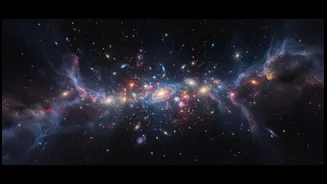
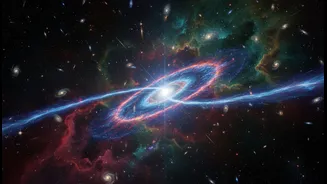
Imagine looking back in time, billions of years, to the dawn of the universe. It’s a period just a few hundred million years after the Big Bang. According to our long-held theories, this cosmic nursery should be filled with young, small galaxies and even
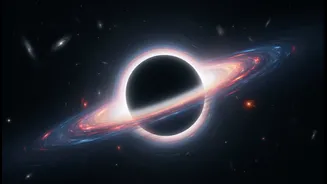
smaller black holes. Yet, powerful tools like the James Webb Space Telescope (JWST) have found something startling: supermassive black holes, some with the mass of millions or even a billion suns, already lurking in the dim light of the cosmic dawn. This discovery has presented scientists with a major conundrum. The traditional recipe for growing a black hole is a slow and steady process, far too slow to explain these ancient behemoths. It’s like finding a fully grown banyan tree in a field where you only planted a seed yesterday. This paradox has sent astrophysicists back to the drawing board to figure out what they might have been missing.
The Standard Recipe's Flaw
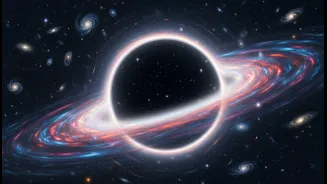
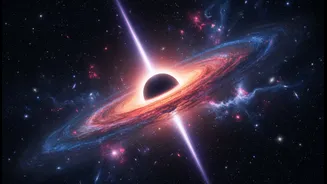
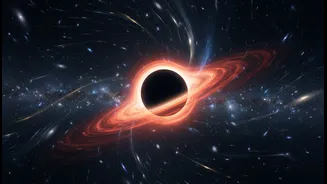
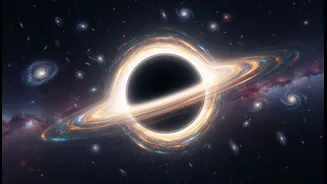
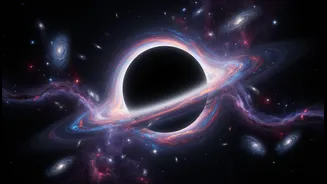
The conventional theory of black hole growth is based on a process called accretion. A black hole, born from the collapse of a massive star, gradually pulls in surrounding gas and dust with its immense gravity. As this material spirals in, it forms a glowing-hot accretion disk. This process is incredibly powerful, but it has a built-in speed limit, known as the Eddington limit. As the black hole feeds, the intense radiation blasted out from the accretion disk pushes back against the infalling gas, effectively putting a brake on its growth. According to this model, it would take longer than the age of the early universe for a stellar-mass black hole to gobble enough matter to reach the supermassive sizes now being observed. The numbers simply don’t add up, suggesting that these primordial giants didn't follow the standard rulebook.
A Faster Pathway: Direct Collapse
To solve this puzzle, scientists are exploring more radical ideas. One of the leading alternative theories is the 'direct collapse' model. Instead of starting from a single dead star, this theory proposes that some supermassive black holes were born big. In the dense, turbulent environment of the early universe, huge clouds of primordial gas, hundreds of thousands of times the mass of our sun, might have collapsed directly into a massive black hole seed without ever forming stars first. This process would give the black hole a tremendous head start, creating a 'heavy seed' that could then grow to supermassive status within the cosmic timeframe. Recent observations have found objects that could be these 'naked' black holes, existing without a host galaxy of stars, lending weight to this paradigm-shifting idea.
Growth Spurts and Feeding Frenzies
Another possibility is that early black holes were simply much greedier eaters than their modern counterparts. A theory known as 'super-Eddington accretion' suggests that under the chaotic conditions of the early cosmos, some black holes could bypass their normal feeding limits. In dense, gas-rich galaxies, black holes may have entered short-lived but incredibly intense growth spurts, devouring matter at rates far beyond what was thought possible. New simulations suggest these 'feeding frenzies' were common in the early universe, allowing black holes to balloon in mass rapidly. Discoveries of ancient quasars—the intensely bright cores of galaxies with actively feeding black holes—that appear to be growing at several times the Eddington limit support the idea that these cosmic giants had periods of extreme, rapid growth.
Rewriting Cosmic History
The confirmation of these faster growth pathways would fundamentally alter our understanding of the universe. The relationship between black holes and their host galaxies has long been a key area of study, with most modern galaxies having a black hole mass that is a tiny fraction of the galaxy's own. However, discoveries from JWST show that in the early universe, many black holes were 'overmassive' compared to their host galaxies, suggesting the black hole grew first and the galaxy formed around it. This flips the traditional 'galaxy-first' model on its head. Understanding these different formation routes is not just about black holes; it’s about piecing together the grand story of cosmic evolution, from the first flickers of light after the Big Bang to the grand spiral galaxies we see today. The universe, it seems, has always been a more dynamic and surprising place than we ever imagined.