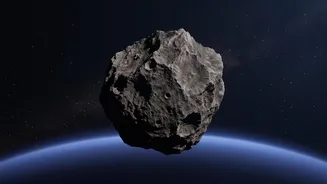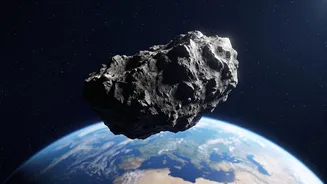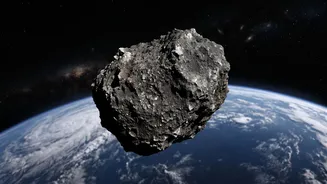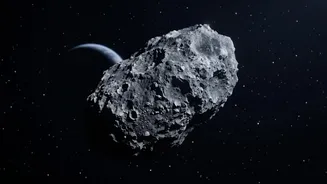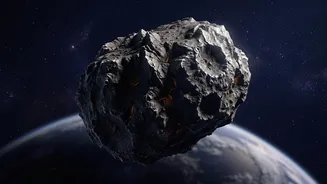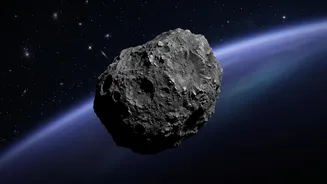







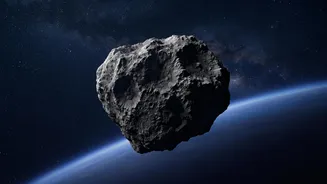

In the vast quiet of space, objects are expected to follow the predictable laws of gravity. But a tiny asteroid named 1998 KY26 is breaking the rules by speeding up, and scientists think the gentle but persistent push of sunlight may be the culprit.
Meet Asteroid 1998 KY26
Discovered
in 1998, 1998 KY26 is a minuscule near-Earth asteroid. Recent observations have dramatically revised our understanding of this space rock. It is now estimated to be only about 11 meters in diameter, roughly the size of a small bus, which is nearly three times smaller than previously thought. This object is also a remarkably fast spinner, completing a full rotation in just over five minutes. Its small size and rapid spin make it an object of immense scientific interest, as it pushes the limits of what we know about how small celestial bodies hold themselves together. It is not considered a hazardous object, but its unique characteristics have made it the final destination for Japan's Hayabusa2 spacecraft, which is scheduled to rendezvous with it in July 2031.
An Unexplained Push
For years, astronomers have tracked the path of 1998 KY26 with incredible precision. They noticed something strange: its orbit was changing in a way that couldn't be explained by the gravitational pull of the Sun and planets alone. The asteroid showed a slight acceleration, particularly in a direction out of its orbital plane. One prominent theory was that 1998 KY26 was a 'dark comet'. This hypothesis suggested the asteroid might contain pockets of ice that, when warmed by the Sun, would turn to gas and vent into space, creating a tiny, invisible jet that would push the asteroid along. However, a recent study has cast doubt on this idea. Using thermal models, researchers determined that the asteroid is likely too warm to have retained water ice for long periods, making the outgassing theory less probable.
The Power of Sunlight
With the dark comet theory looking less likely, attention has turned to another subtle but powerful force: solar radiation. This comes in two main forms. The first is simple radiation pressure, where photons from the Sun physically push on the asteroid. While this force is real, a more complex phenomenon known as the Yarkovsky effect is believed to be the primary driver of the orbital change. The Yarkovsky effect occurs because an asteroid absorbs sunlight and then re-radiates that energy back into space as heat. Due to the asteroid's rotation and thermal lag—the time it takes for the surface to heat up and cool down—this heat is not emitted evenly in all directions. The 'afternoon' side of the rotating asteroid is the hottest and radiates the most heat. This anisotropic emission of thermal photons creates a minuscule but constant recoil force, like an incredibly weak thruster, that can alter an asteroid's orbit over thousands or millions of years. For a small, fast-spinning rock like 1998 KY26, this effect can be significant enough to be measured.
Why This Tiny Shove Matters
Understanding the non-gravitational forces acting on asteroids is crucial for several reasons. Firstly, it refines our models of the solar system's evolution, explaining how asteroids drift over eons. Secondly, and more critically, it is vital for planetary defense. If we ever need to predict the long term path of a potentially hazardous asteroid, we must account for subtle pushes from effects like Yarkovsky. Studying 1998 KY26 provides a perfect real world laboratory for these forces. The mystery of its acceleration highlights the incredible precision of modern astronomy, where even a whisper of force from sunlight can be detected from millions of kilometers away. While current models combining solar radiation pressure and the Yarkovsky effect seem to be the best explanation, the final answer may have to wait for a closer look.