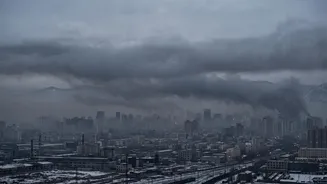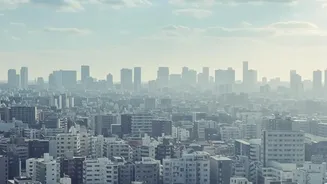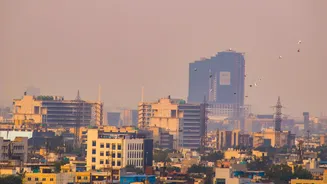




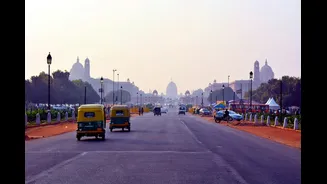
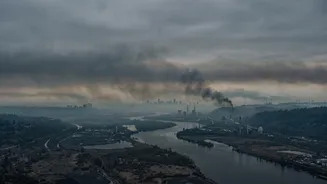
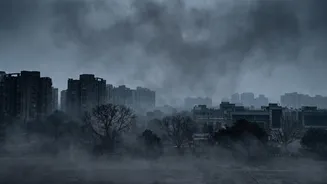
Every winter, Delhi's air quality plummets, a familiar crisis for its residents. While many factors are blamed, a surprising contributor is the city's own heat. Here’s how the urban heat island effect interacts with winter's cold to trap us in smog.
What Is an Urban Heat Island?
An
urban heat island (UHI) is a phenomenon where a metropolitan area is significantly warmer than its surrounding rural areas. This happens because cities are dense with materials like concrete, asphalt, and dark-coloured roofs that absorb and retain more of the sun's heat than natural landscapes like forests and fields. In Delhi, this effect is well-documented. Studies have shown that during the night, parts of the city can be 4-8°C warmer than nearby rural areas. This retained heat is a result of dense construction, a decline in green cover, and heat generated from vehicles, industries, and air conditioning units. While we often associate this extra warmth with summer discomfort, it plays a more sinister role during the winter months.
The Natural Winter Weather Trap
Winter in North India brings a specific meteorological condition known as a temperature inversion. Normally, air temperature decreases the higher you go in the atmosphere. This allows warmer, lighter air near the ground to rise, carrying pollutants with it and dispersing them. However, during calm winter nights, the ground cools rapidly, making the air closest to the surface colder and denser than the air layer above it. This creates an inversion: a layer of warm air sitting on top of a layer of cold air, acting like an atmospheric lid. This lid, combined with low wind speeds and the bowl-like geography of the Indo-Gangetic Plain, prevents the vertical mixing of air and traps everything underneath it.
A Toxic Combination for Air Quality
When the urban heat island effect meets a winter temperature inversion, the situation worsens dramatically. The city's stored heat from its concrete infrastructure prevents the surface air from cooling down as much as it would in a rural setting. This strengthens the inversion layer above. The warm 'lid' becomes more robust, and the mixing height—the altitude to which pollutants can disperse—is drastically reduced. In summer, this mixing height might be a kilometre or more, but in winter, it can shrink to just a few hundred metres. This means the same amount of pollution is concentrated in a much smaller volume of air, leading to a rapid spike in pollutant concentrations at ground level, where people breathe.
What Gets Trapped Under the Lid?
The trapped air is a toxic soup of pollutants from various sources. The primary culprits are fine particulate matter (PM2.5 and PM10), nitrogen oxides (NOx), carbon monoxide (CO), and volatile organic compounds (VOCs). These emissions come from a combination of sources. Vehicular emissions are a consistent major contributor, accounting for a significant percentage of PM2.5 in winter. Other major sources include industrial pollution, dust from construction sites, and biomass burning, which includes both garbage burning within the city and stubble burning in neighbouring states. Even household activities, like using firewood or cow dung cakes for heating in winter, contribute to the local pollution load that gets trapped. Research by SAFAR has shown a direct correlation between the intensity of the urban heat island effect and PM2.5 concentrations.
Why This Matters for Delhi's Residents
This dangerous interaction means that the very structure of the city exacerbates its pollution problem. The heat that provides a slight buffer against the winter chill at night is also helping to lock in harmful pollutants. This leads to the 'severe' and 'hazardous' air quality index (AQI) readings that have become a hallmark of Delhi's winters. The health impacts are severe, contributing to respiratory illnesses, cardiovascular problems, and other chronic conditions, particularly for the vulnerable, including children, the elderly, and outdoor workers. The phenomenon also creates what some reports call 'cooling inequity', where those without access to air purifiers and well-sealed homes bear the brunt of the pollution crisis.