

More Than Just a Shooting Star
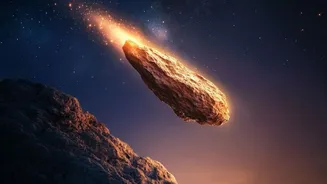
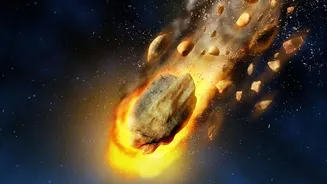
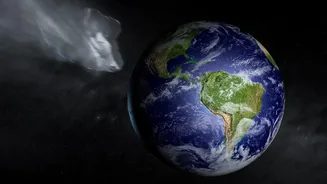
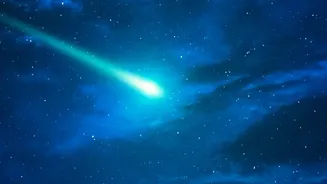
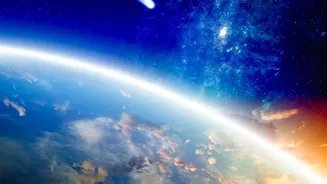
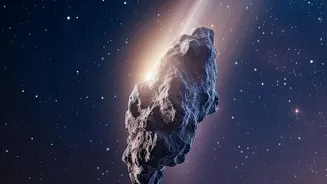
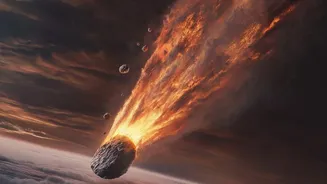
First, let's get the terms right. That flash in the night sky is a meteor, which is the visible path of a meteoroid—a small piece of rock or debris from space—as it enters Earth's atmosphere and burns up. If a piece of it survives the fiery descent and lands
on the ground, it's called a meteorite. Scientists are interested in both. Networks of automated cameras around the world, like the NASA All Sky Fireball Network, are constantly watching the skies. Their main job isn't just to spot pretty light shows; it's to precisely record the trajectory, speed, and brightness of these meteors. This data is the first step in a fascinating detective story that takes us back to the dawn of the solar system.
A Cosmic Chemical Fingerprint
As a meteoroid burns up in the atmosphere, the intense heat vaporizes its minerals. The light emitted during this process is not just random; it contains a chemical signature. Scientists use a technique called spectroscopy to analyse this light, breaking it down into its component colours, much like a prism makes a rainbow. Each element—like iron, nickel, or magnesium—burns with a unique colour profile. By reading these 'spectral fingerprints', researchers can determine the chemical makeup of the meteoroid without ever touching it. This tells them what kind of parent body it came from—whether it was a rocky asteroid or an icy comet—and provides a sample of the raw materials that were present in different parts of the early solar system.
Tracing the Path Back Home
This is where the 'tracking' part becomes crucial. By using data from multiple camera stations that recorded the same meteor from different angles, scientists can triangulate its exact path through the atmosphere. From there, they can work backwards, calculating its original orbit around the Sun before it encountered Earth. This allows them to link a specific meteor to its source region, such as the main asteroid belt between Mars and Jupiter, or even a specific family of asteroids or the trail of debris left by a known comet. In a 2024 case, a rapidly recovered meteorite in New Jersey was traced back to a specific asteroid family, giving scientists both the rock and its cosmic address. This combination of knowing what a meteor is made of and where it came from is incredibly powerful.
Time Capsules from Billions of Years Ago
Meteorites that are recovered on Earth are like physical time capsules. Some, called chondrites, are particularly special because they are essentially unaltered samples of the primordial dust and gas that formed everything in our solar system. They contain tiny, ancient grains that predate our Sun itself. By studying the isotopic composition of these meteorites—the different 'flavours' of elements within them—scientists can date them with incredible precision and understand the conditions in the solar nebula 4.6 billion years ago. For instance, the ratio of different types of oxygen can reveal whether a rock formed in the hot inner solar system or the colder outer regions, separated by the immense gravity of a young Jupiter.
Unlocking the Secrets of Planet Formation
Ultimately, all this information helps us piece together the story of how we got here. The composition of meteorites reveals the building blocks of planets. Iron meteorites are thought to be samples of the metallic cores of early planetesimals (small, forming planets), while stony meteorites come from their mantles and crusts. By studying them, we can understand how planets like Earth developed their layered structures. Furthermore, some meteorites, known as carbonaceous chondrites, are rich in water and organic compounds, including amino acids. Their presence supports the theory that meteorites may have delivered the essential ingredients for life to a young Earth billions of years ago.